NCERT Class 7 Maths Ganita Prakash Chapter 3 A Peek Beyond The Point Solutions (2026-27)
3.1 The Need for Smaller Units
NCERT In-Text Questions (Pages 46 – 48)
Question: In the following figure, screws are placed above a scale. Measure them and write their length in the space provided.
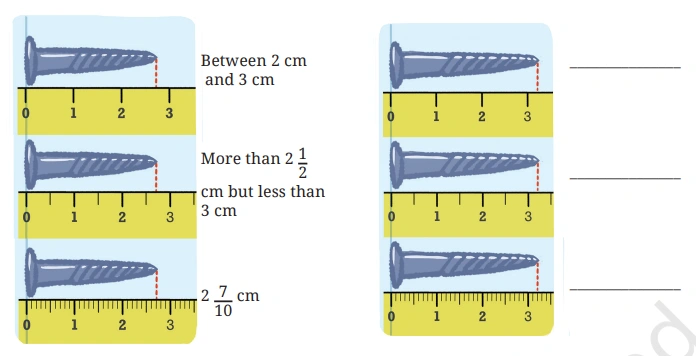
Solution:
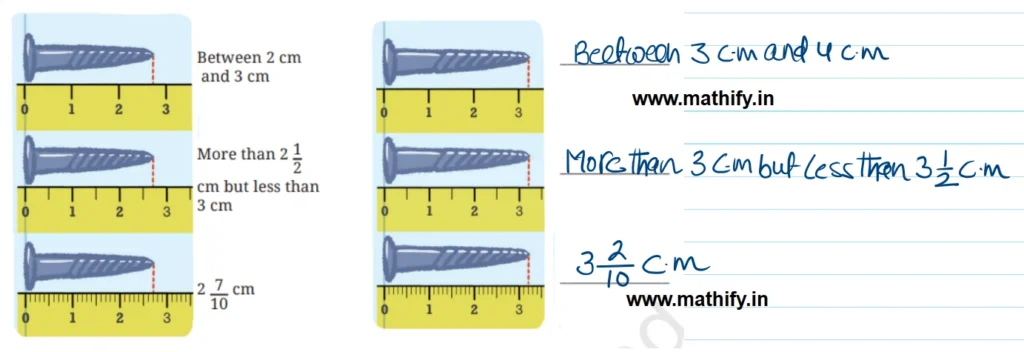
Question: Which scale helped you measure the length of the screws accurately? Why?
Solution:
“The third scale allowed us to measure the screws more precisely, as each unit length was subdivided into ten equal parts.”
Q. What is the meaning of 27/10 cm (the length of the first screw)?
Solution:-
It means that the length of the screw is two and seven-tenth centimeters.
Question: Can you explain why the unit was divided into smaller parts to measure the screws?
Solution:
- When an object is too long to be measured in exact whole units, the unit of length is divided into smaller equal parts.
- These smaller parts are called subunits (for example, centimeters are subunits of a meter, millimeters are subunits of a centimeter).
- By using subunits, we can measure the screw’s length more precisely instead of rounding it to the nearest whole unit.
For instance:
- If a screw is longer than 7 cm but shorter than 8 cm, we divide the centimeter into millimeters to measure it exactly, say 7.6 cm.
Question: Measure the following objects using a scale and write their measurements in centimeters (as shown earlier for the lengths of the screws): pen, sharpener, and any other object of your choice.
Solution:
Do it Yourself
Question: Write the measurements of the objects shown in the picture:
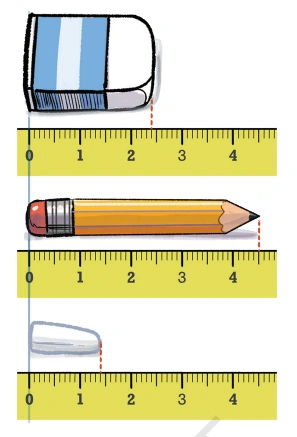
Solution:
- Eraser: 2.4 cm
- Pencil: 4.5 cm
- Chalk: 1.4 cm
3.2 A Tenth Part
NCERT In-Text Questions Pages (49-52)
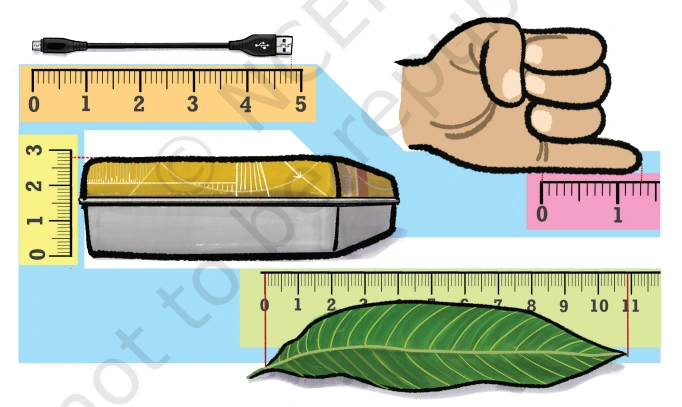
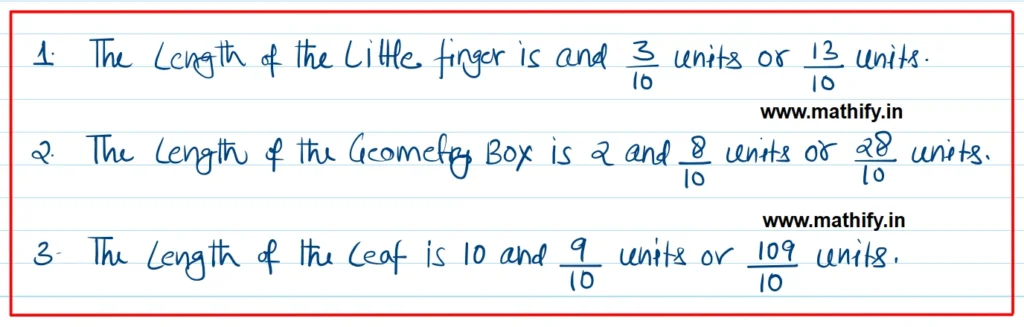
Question: For the objects shown below, write their lengths in two ways and read them aloud. An example is given for the USB cable. (Note that the unit length used in each diagram is not the same). The length of the USB cable is 4 and 8/10 units or 48/10 units.
Solution:
Question: Arrange these lengths in increasing order:
(a) 9/10 (b) 17/10
(c) 130/10 (d) 131/10
(e) 105/10 (f) 76/10
(g) 6 7/10 (h) 4/10
Solution:-
Let’s carefully arrange those lengths step by step:
Convert all to decimals (or improper fractions for clarity)
- (h) ( 4/10 = 0.4 )
- (a) ( 9/10 = 0.9 )
- (b) ( 17/10 = 1.7 )
- (g) ( 6 7/10 = 6.7 )
- (f) ( 7 6/10 = 7.6 )
- (e) ( 105/10 = 10.5 )
- (d) ( 131/10 = 13.1 )
- (c) (130/10 = 13.0 )
Now arrange in increasing order
[ (h) 0.4 < (a) 0.9 < (b)1.7 < (g) 6.7 < (f) 7.6 < (e) 10.5 < (c) 13.0 < (d) 13.1 ]
Final Answer
Increasing order: (h), (a), (b), (g), (f), (e), (c), (d) ✅
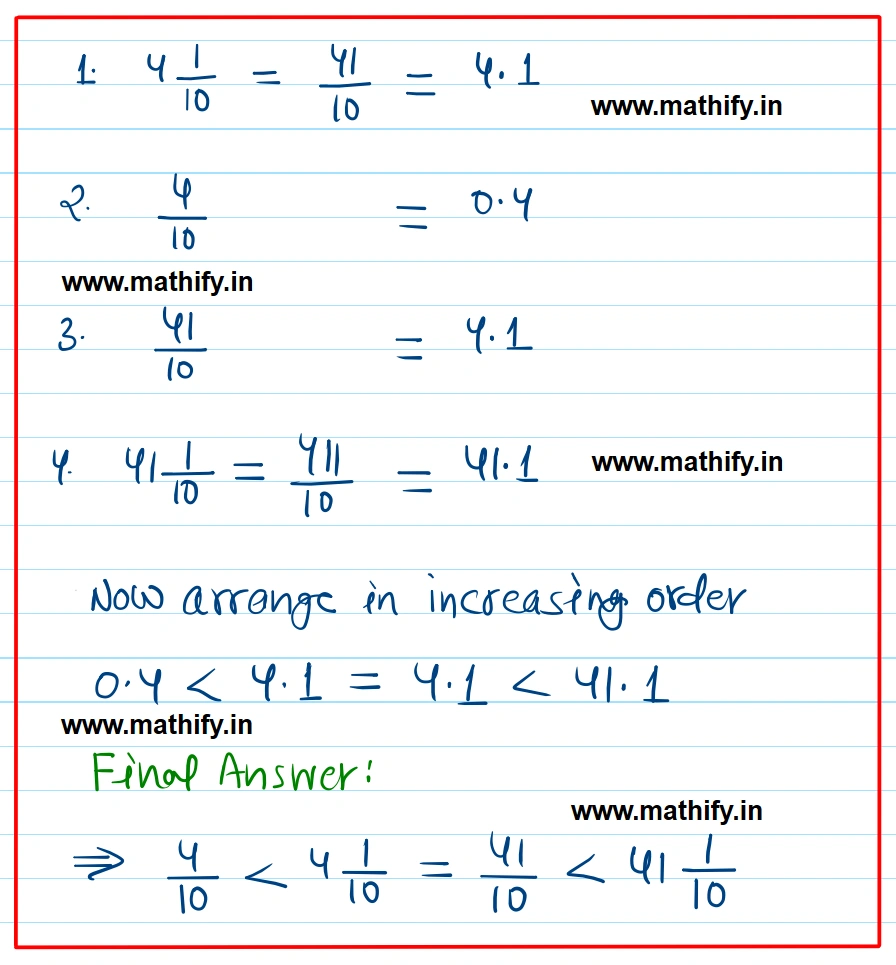
Question: Arrange the following lengths in increasing order: 41/10, 4/10, 41/10, 411/10.
Solution:
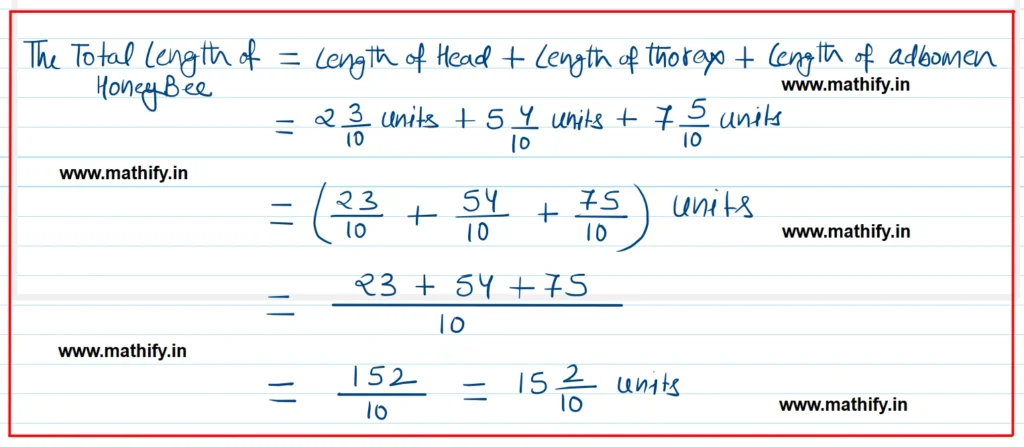
Question: The lengths of the body parts of a honeybee are given. Find its total length.

Head: 2 3/10 units
Thorax: 5 4/10 units
Abdomen: 7 5/10 units
Solution:-
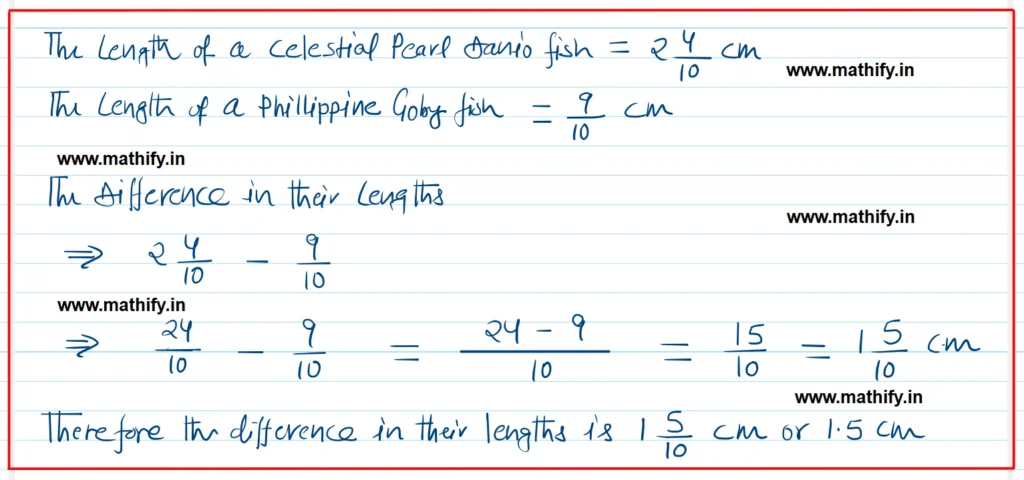
Question: A Celestial Pearl Danio’s length is 2 4/10 cm, and the length of a Philippine Goby is 9/10 cm. What is the difference in their lengths?
Solution:
Question: How big are these fish compared to your finger?

Solution:
Do it Yourself
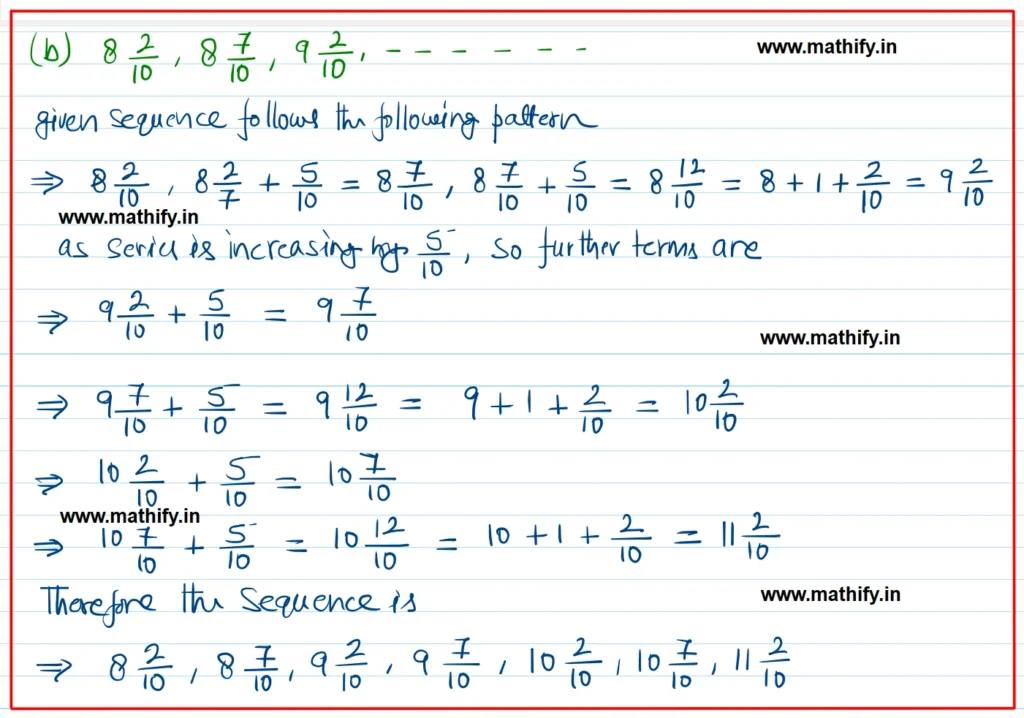
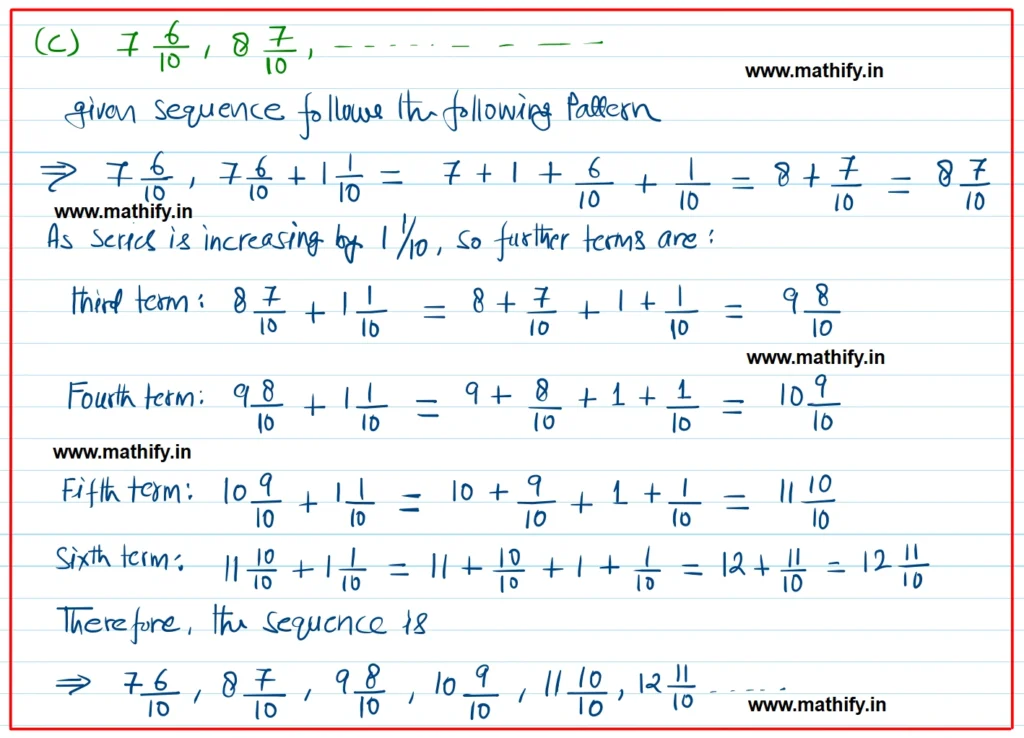
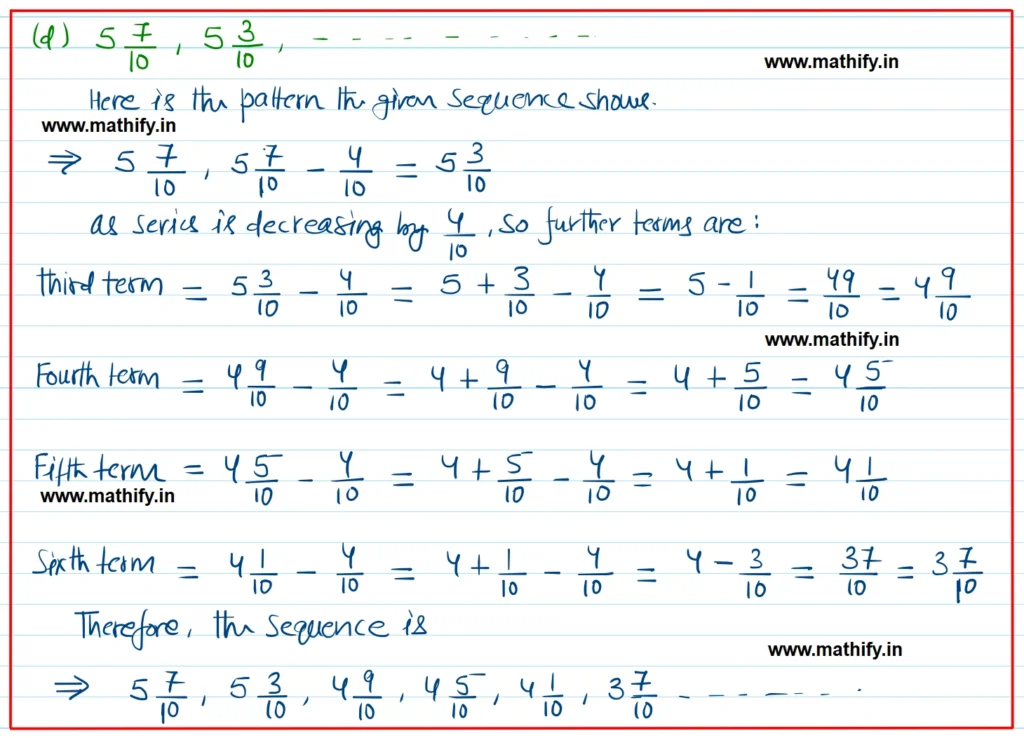
Question: Observe the given sequences of numbers. Identify the change after each term and extend the pattern:
(a) 4, 4 3/10 , 4 6/10 , , , ,
(b) 8 2/10 , 8 7/10 , 9 2/10 , , , ,
(c) 7 6/10 , 8 7/10 , , , ,
(d) 5 7/10 , 5 3/10 , , , ,
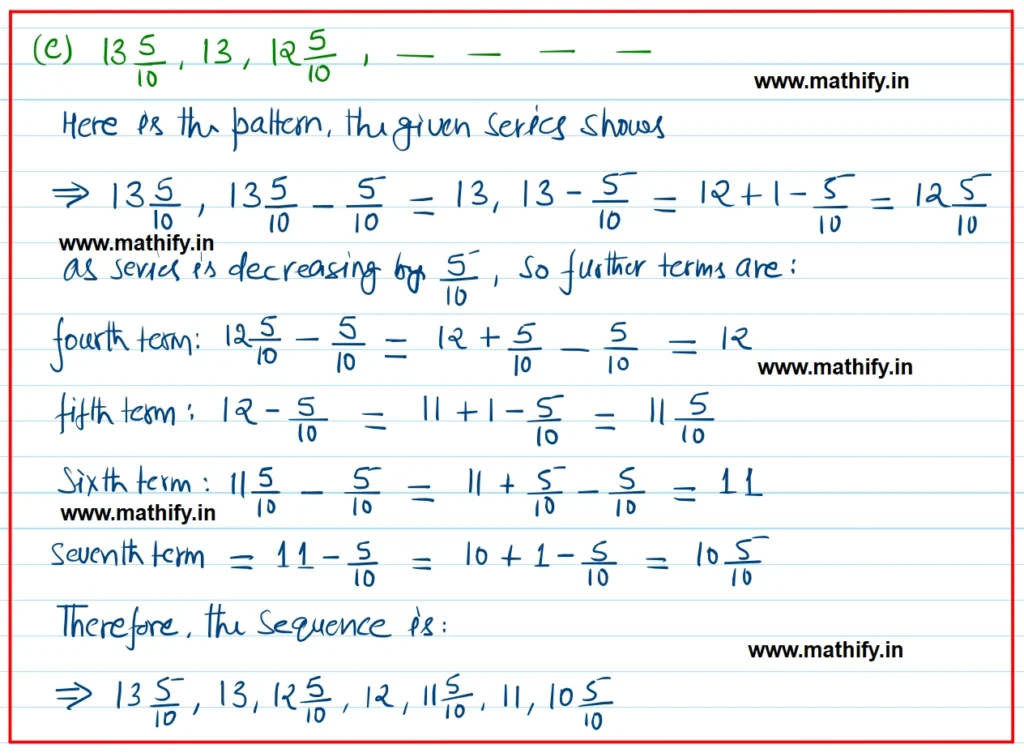
(e) 13 5/10 , 13, 12 5/10 , , , ,
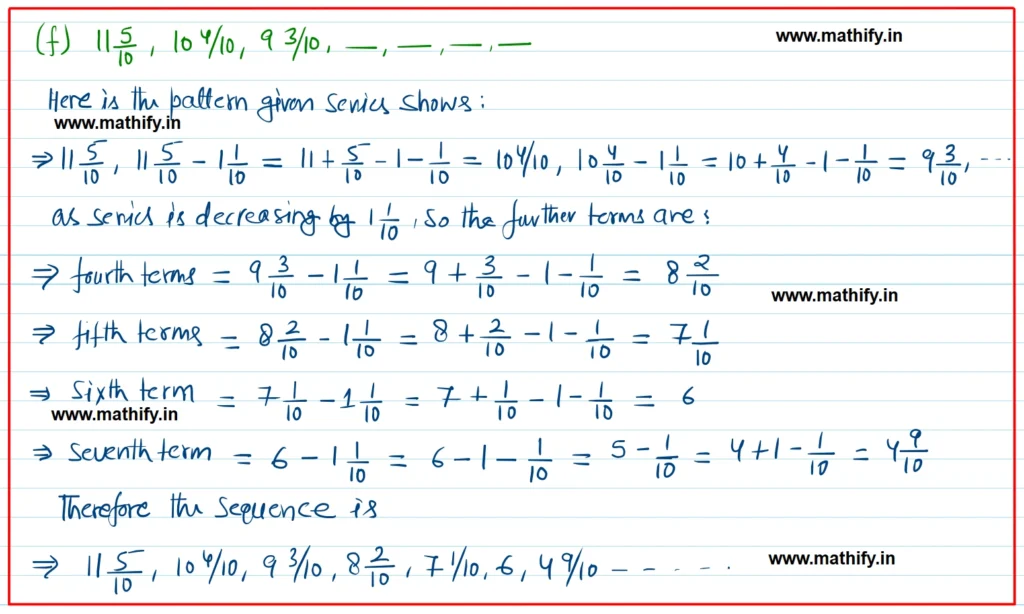
(f) 11 5/10 , 10 4/10 , 9 3/10 , , , ,
Solution:

3.3 A Hundredth Part
NCERT In-Text Questions (Pages 53)
Question: How many one-hundredths make one-tenth? Can we also say that the length is 4 units and 45 one-hundredths?
Solution:
1. How many one-hundredths make one-tenth?
- One-tenth is written as ( 1/10 ).
- To express it in hundredths, we convert:
[ 1/10 = 10/100 ] - So, 10 one-hundredths make one-tenth.
2. Can we say the length is 4 units and 45 one-hundredths?
- Yes, that’s correct.
- ( 4 45/100 ) is another way of writing 4.45.
- This means the length is 4 whole units plus 45 parts out of 100 (i.e., 45 hundredths).
- It’s the same as saying 4.45 units.
✅ Final takeaway:
- (1/10 = 10/100 )
- ( 4.45 = 4 45/100 )
NCERT In-Text Questions (Pages 54-56)
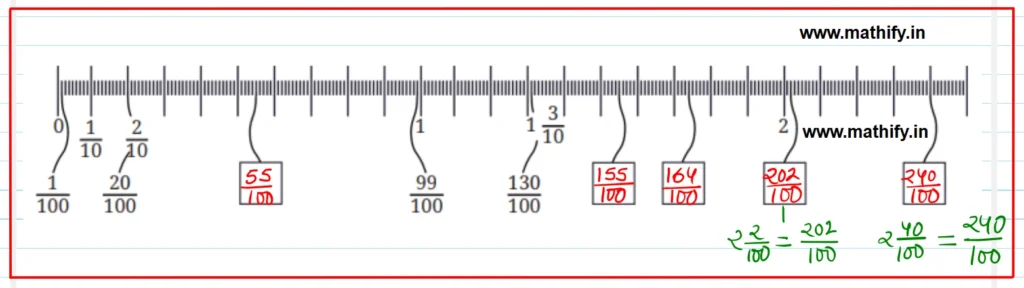
Question: Observe the figure below. Notice the markings and the corresponding lengths written in the boxes when measured from 0. Fill the lengths in the empty boxes.

Solution:
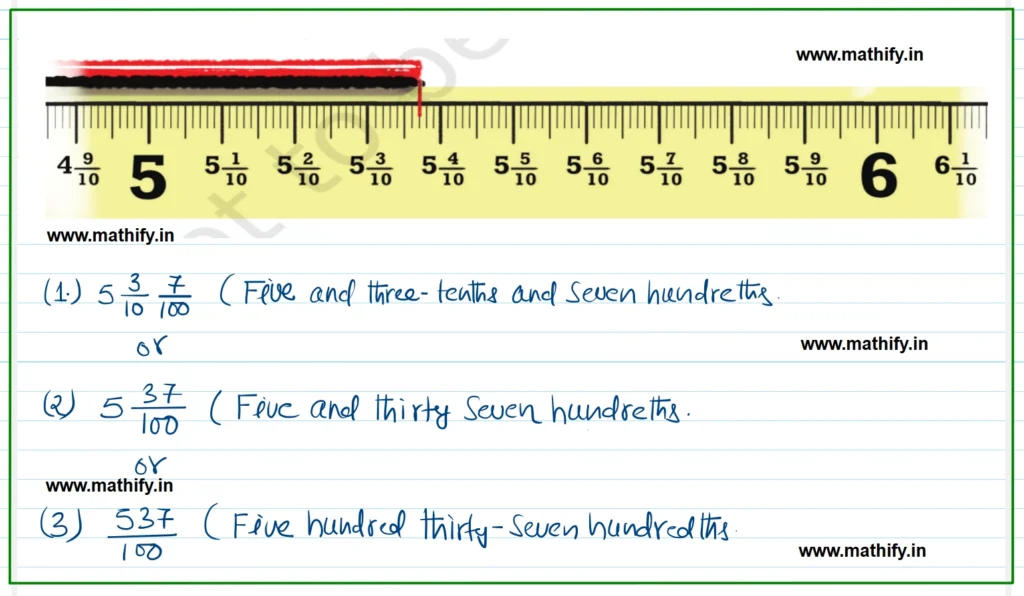
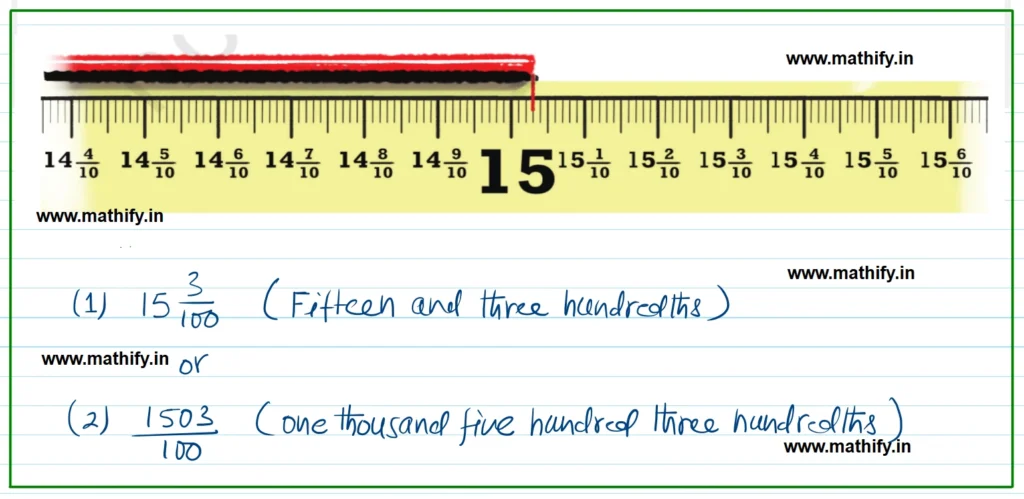
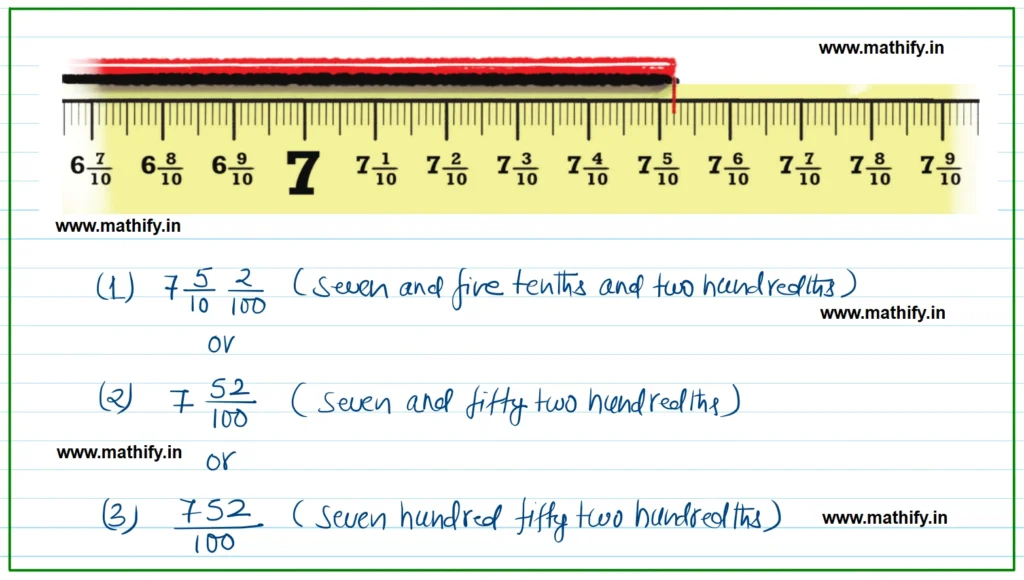
Question: For the lengths shown below write the measurements and read out the measures in words.
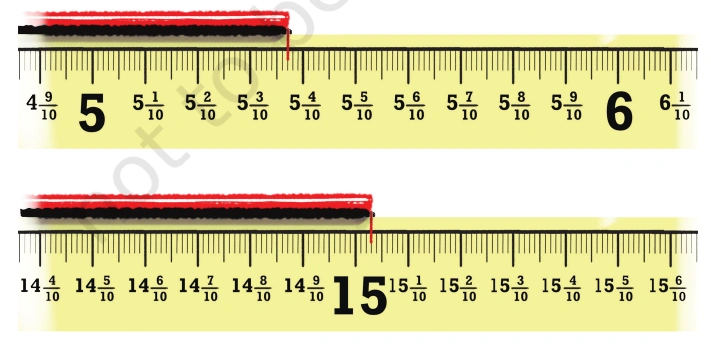
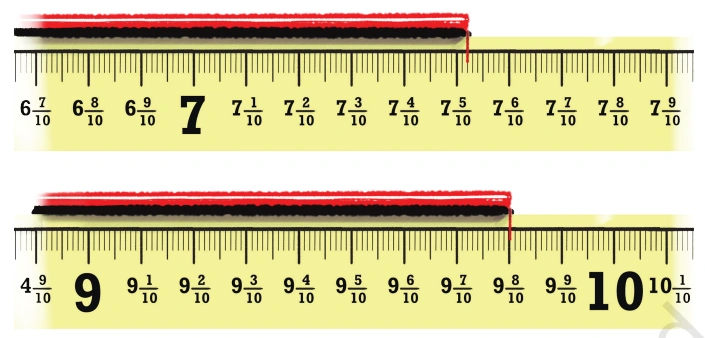
Solution:

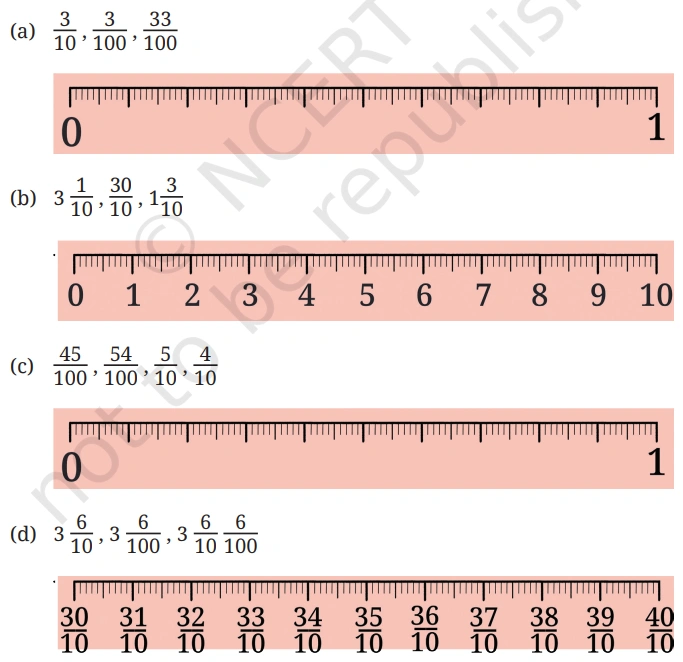
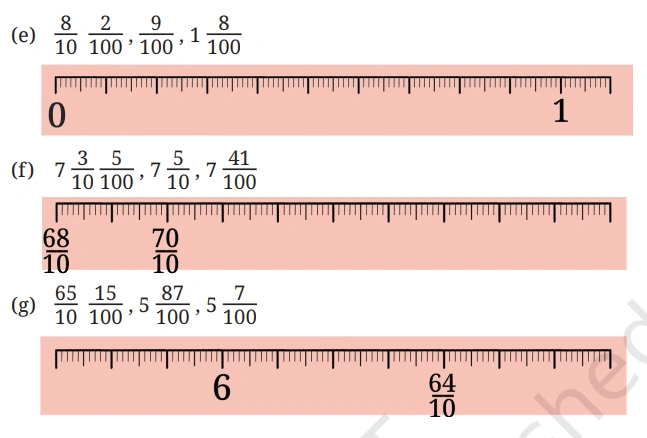
Question: In each group, identify the longest and the shortest lengths. Mark each
length on the scale.
Solution:
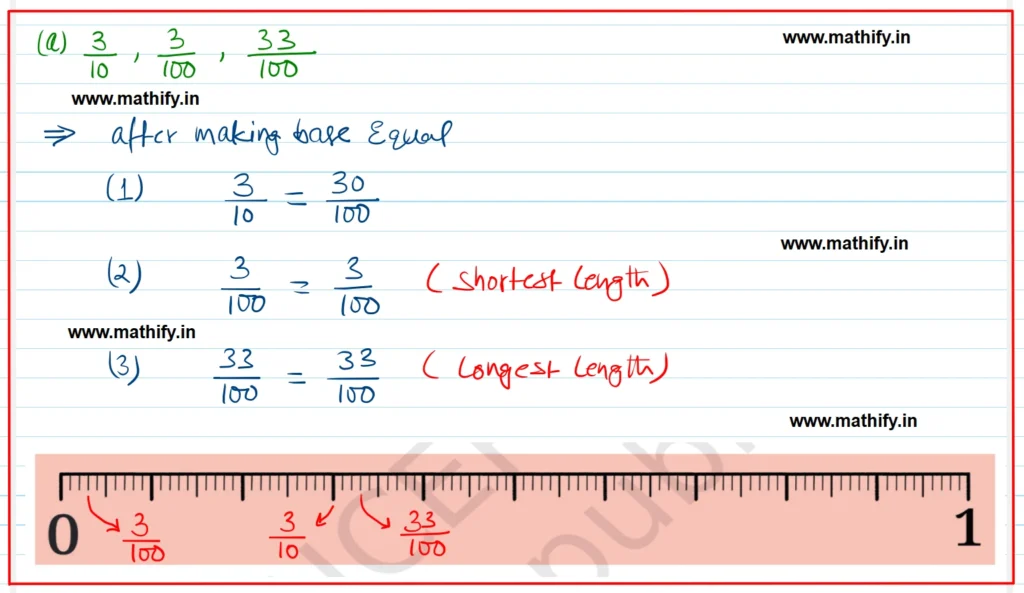


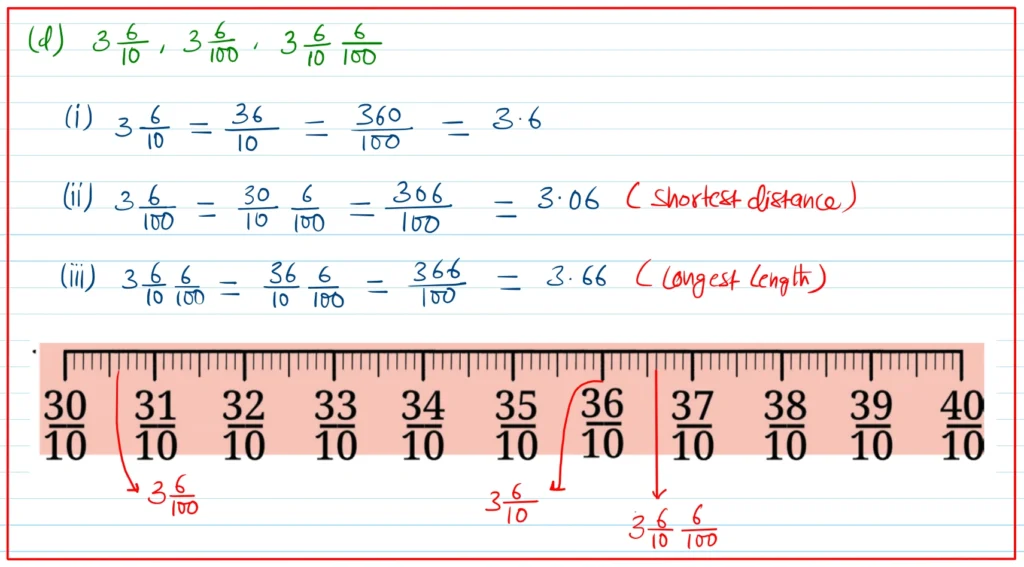


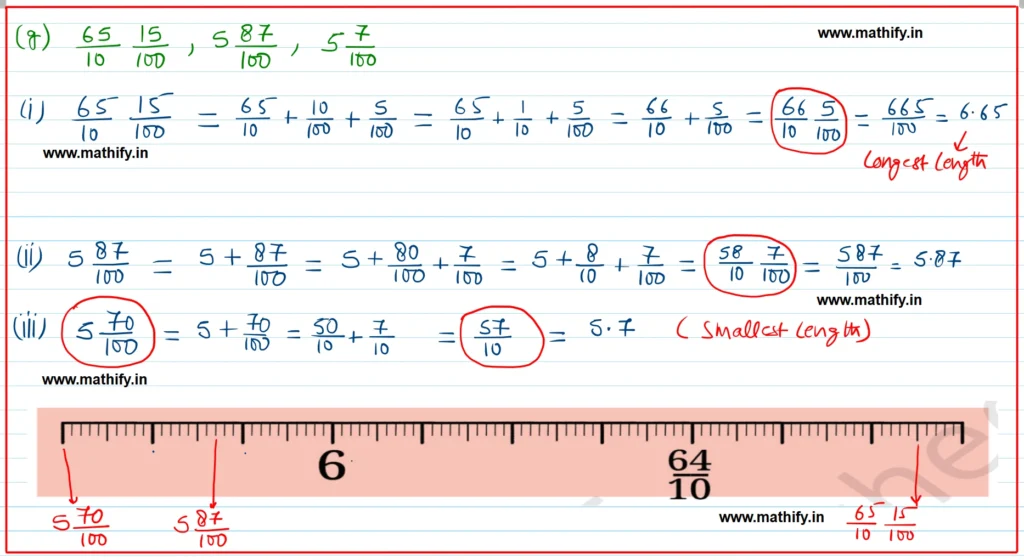
Figure it Out Page 58
Question: Find the sums and differences:
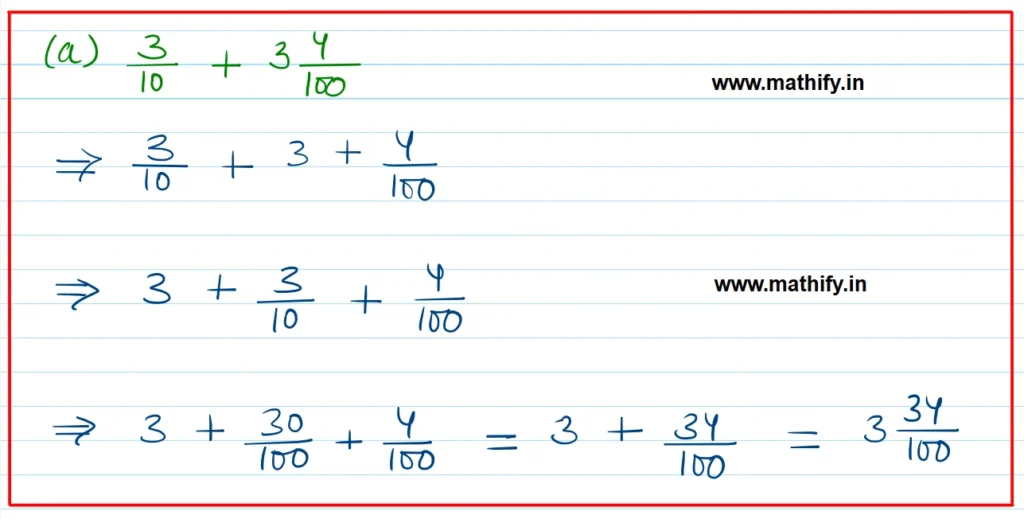
(a) 3/10 + 3 4/100
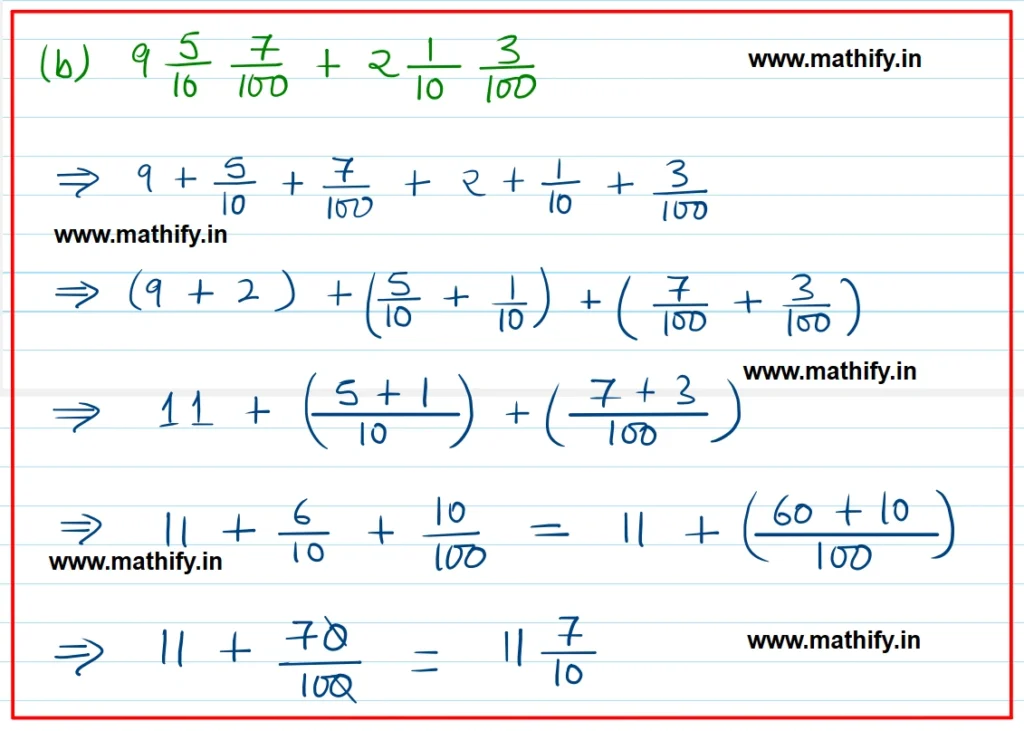
(b) 9 5/10 7/100 + 2 1/10 3/100
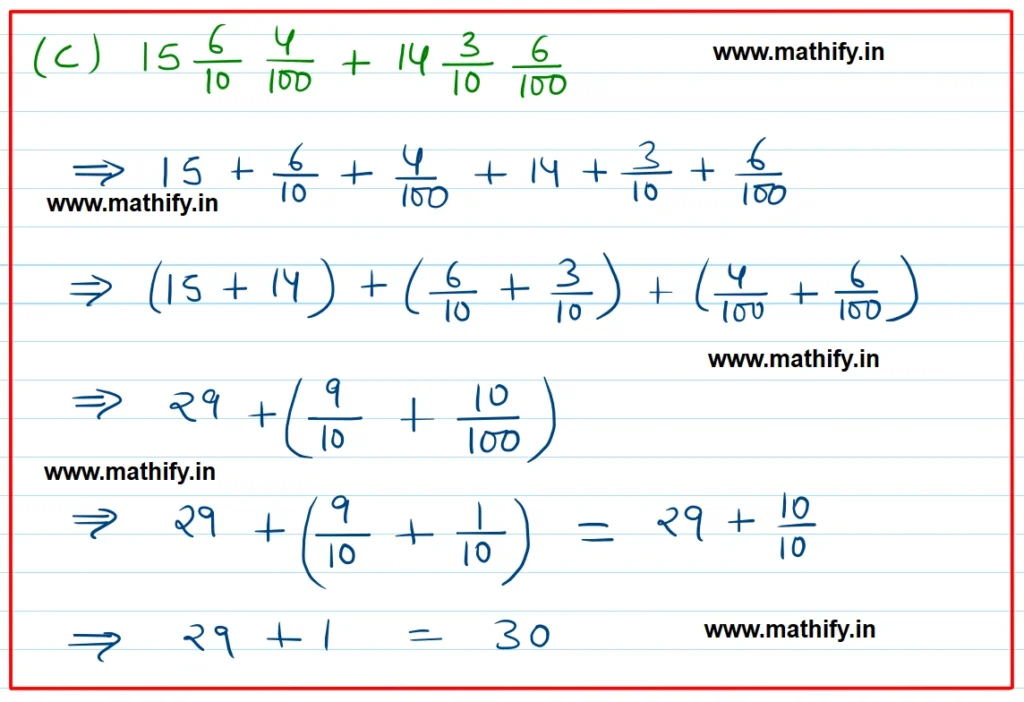
(c) 15 6/10 4/100 + 14 3/10 6/100
(d) 7 7/100 – 4 4/100
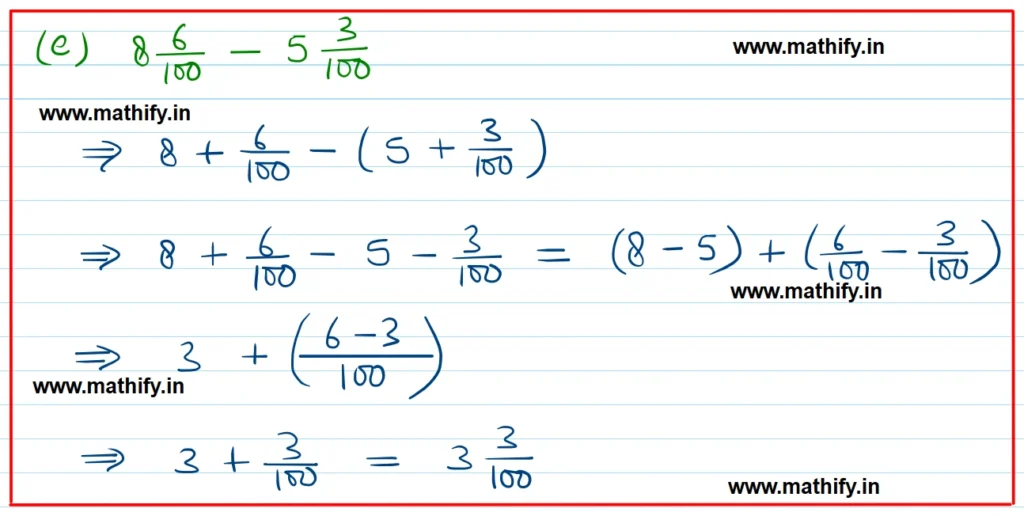
(e) 8 6/100 – 5 3/100
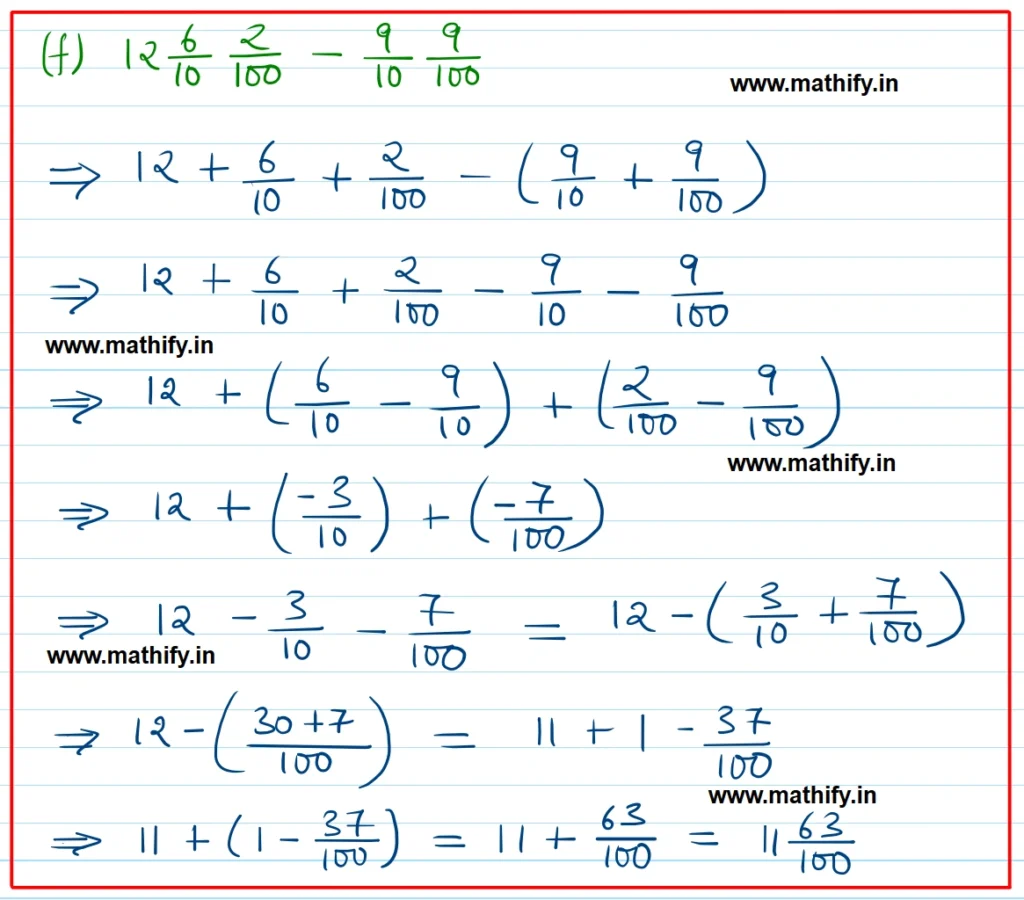
(f) 12 6/100 2/100 – 9/10 9/100
Solution:

NCERT In-Text Questions Pages (60)
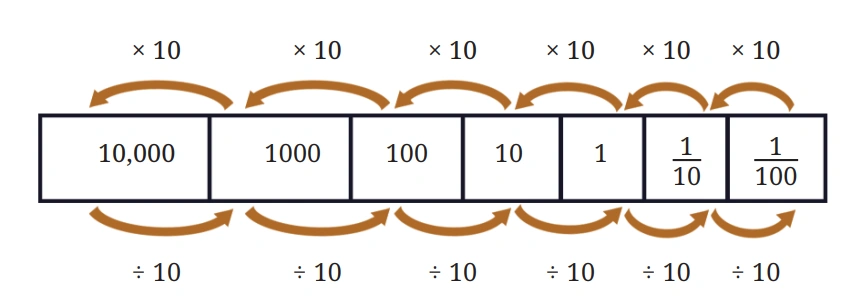
Q. Can we extend this further?
Solution:-
Yes, it can be extended on both side infinitely.

3.4 Decimal Place Value
NCERT In-Text Questions Pages (61-64)
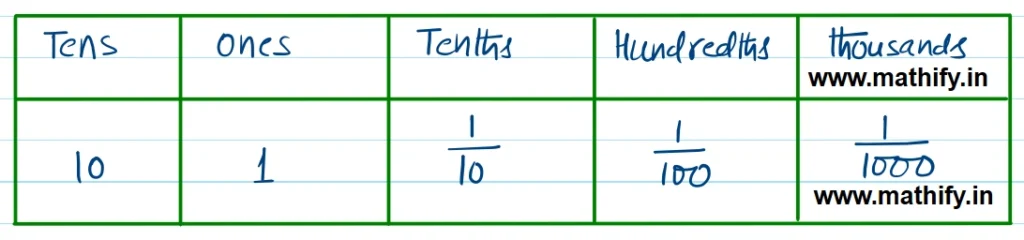
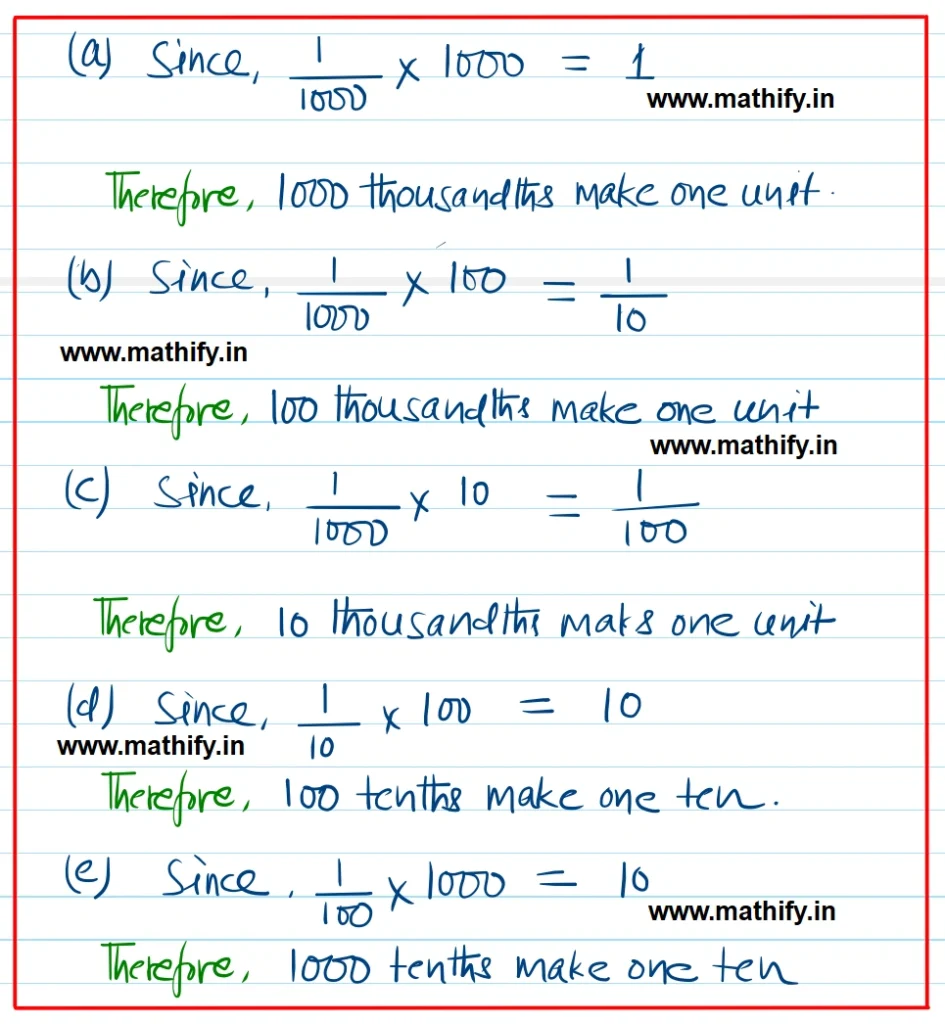
Question: We can ask similar questions about fractional parts:
(a) How many thousandths make one unit?
(b) How many thousandths make one tenth?
(c) How many thousandths make one hundredth?
(d) How many tenths make one ten?
(e) How many hundredths make one ten?
Solution:
Question: Make a few more questions of this kind and answer them
Solution:
Make such questions by yourself.
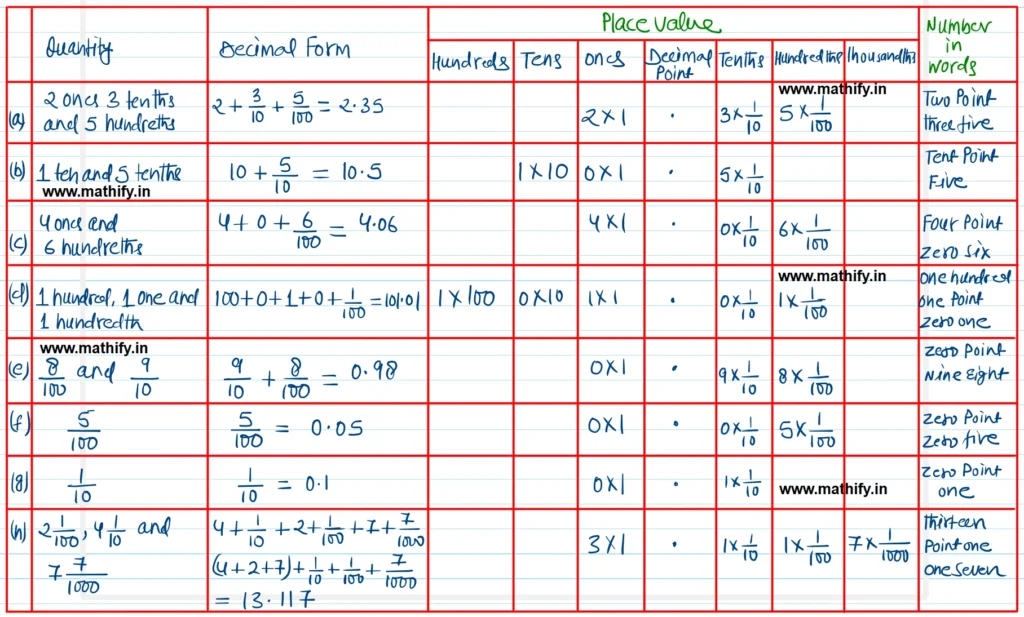
Question: Make a place value table similar to the one above. Write each quantity in decimal form and in terms of place value, and read the number:
(a) 2 ones, 3 tenths and 5 hundredths
(b) 1 ten and 5 tenths
(c) 4 ones and 6 hundredths
(d) 1 hundred, 1 one and 1 hundredth
(e) 8/100 and 9/10
(f) 5/100
(g) 1/10
(h) 2 1/100 , 4 1/10 and 7 7/1000
Solution:-
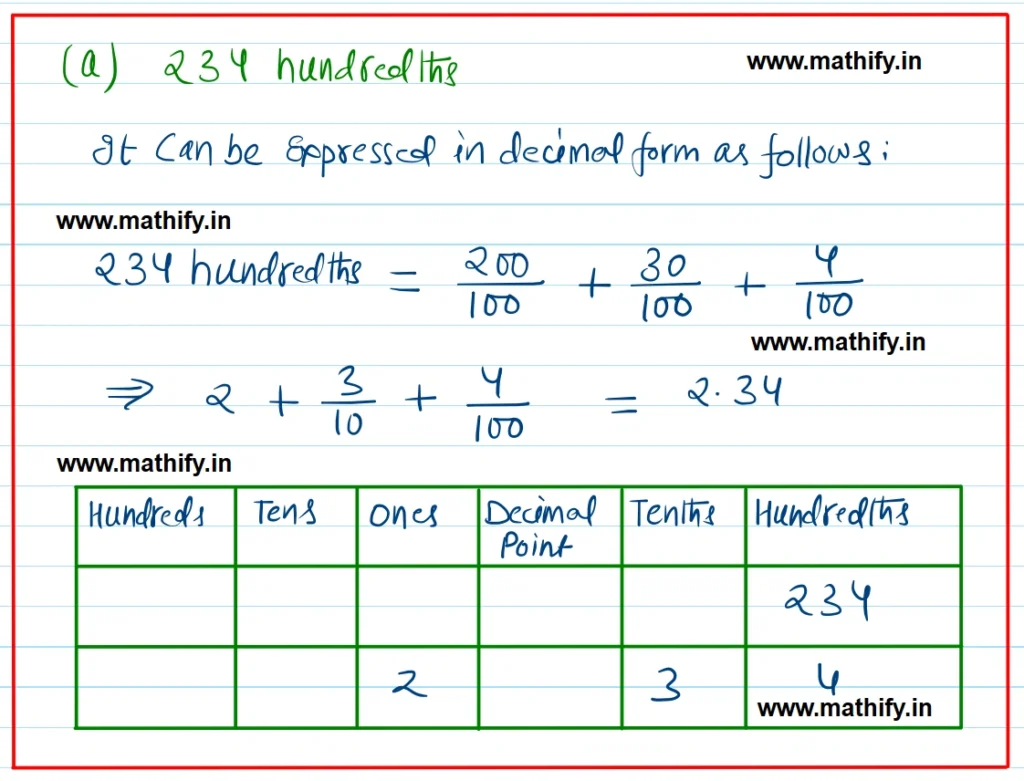
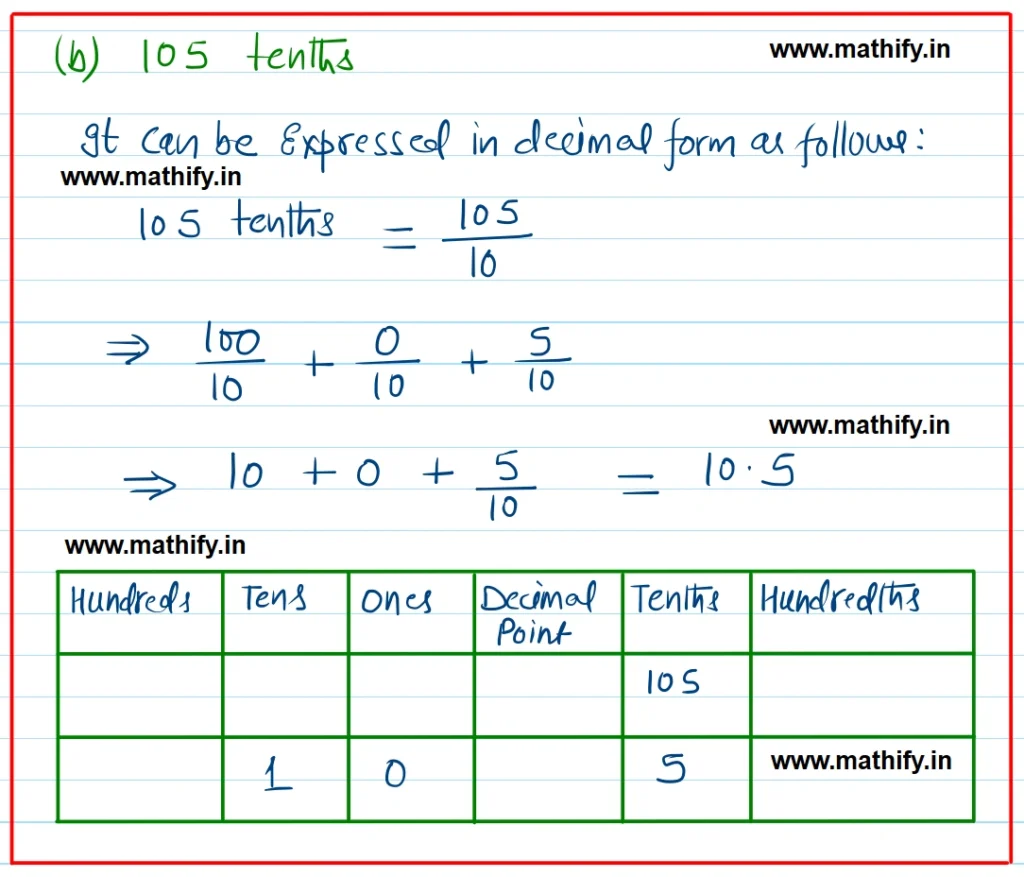
Question: Write these quantities in decimal form:
(a) 234 hundredths,
(b) 105 tenths.
Solution:
3.5 Units of Measurement
Length Conversion
NCERT In-Text Questions Pages (65-66)
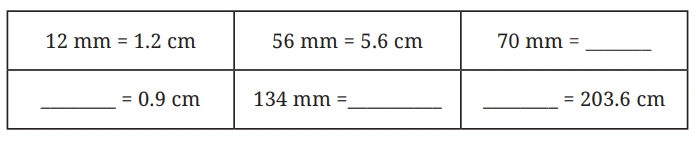
Question: Fill in the blanks below (mm <–> cm):
Solution:
Great, let’s carefully fill in the missing conversions from your worksheet. Remember:
Rule: 10 mm = 1 cm. or 1 mm = 1/10 cm
So, to convert mm → cm, divide by 10.
To convert cm → mm, multiply by 10.
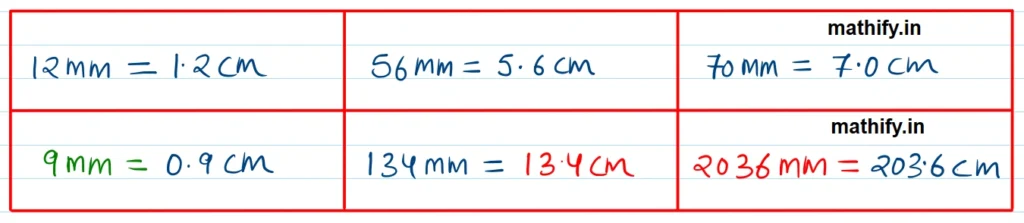
Completed Table
- 12 mm = 12/10 = 1.2 cm ✅
- 56 mm = 56/10 = 5.6 cm ✅
- 70 mm 70/10 = 7 cm
- 9 mm = 9/10 = 0.9 cm
- 134 mm = 134/10 = 13.4 cm
- 2036 mm = 2036/10 = 203.6 cm
✨ Tip for students:
- If the number is in mm, just move the decimal one place to the left to get cm.
- If the number is in cm, move the decimal one place to the right to get mm.
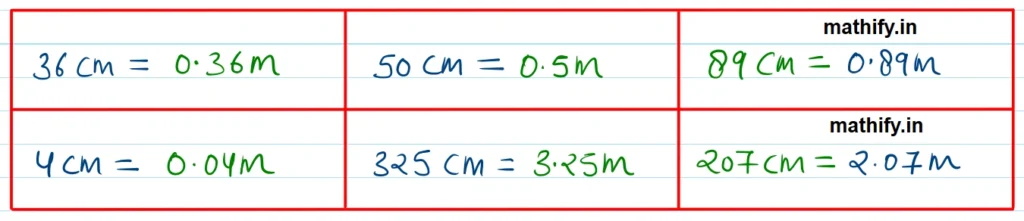
Question: Fill in the blanks below (cm <–> m):

Solution:
Let’s fill in the missing conversions step by step.
Rule: 100cm = 1 m
So, to convert cm → m, divide by 100.
To convert m → cm, multiply by 100.
Completed Table
- 36 cm = 0.36 m
- 50 cm = 0.50 m
- 89 cm = 0.89 m
- 4 cm = 0.04 m
- 325 cm = 3.25 m
- 207 cm = 2.07 m
✨ Quick tip for students:
- If the number is in cm, move the decimal two places left to get m.
- If the number is in m, move the decimal two places right to get cm.
Question: How many mm does 1 meter have?
Solution:
1 meter has 1000 millimeters.
Explanation
- 1m = 100 cm
- 1 cm = 10 mm
- So, (100 cm x 10 mm = 1000 mm
A quick memory trick for students:
- “Meters to millimeters = add three zeros.”
Example: 2 m = 2000 mm
Weight Conversion
NCERT In-Text Questions Pages (67-68)
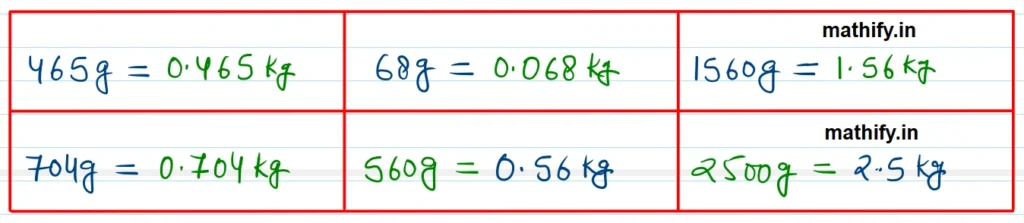
Question: Fill in the blanks below (g <–> kg).

Solution:

Rupee-Paise Conversion
NCERT In-Text Questions Page 69
Question: Fill in the blanks below (rupee <–> paise)

Solution:
Let’s fill in the currency conversion table step by step.

Rule: (100 = ₹1).
So, to convert paise → rupees, divide by 100.
To convert rupees → paise, multiply by 100.

Quick tip for learners:
- If the number is in paise, move the decimal two places left to get rupees.
- If the number is in rupees, move the decimal two places right to get paise.
3.6 Locating and Comparing Decimals
NCERT In-Text Questions Page 70
Question: Name all the divisions between 1 and 1.1 on the number line.

Solution:
Between 1 and 1.1 on the number line, the divisions are in hundredths. That means we count in steps of 0.01.
All divisions between 1 and 1.1:
- 1.01
- 1.02
- 1.03
- 1.04
- 1.05
- 1.06
- 1.07
- 1.08
- 1.09
- 1.10
So, there are 10 equal divisions between 1 and 1.1, each representing 0.01.
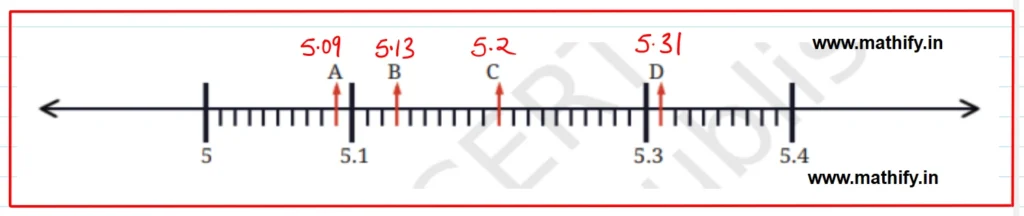
Question: Identify and write the decimal numbers against the letters.

Solution:
Quick Tip:
If we observe the number line between 5.1 to 5.3. There is a gap of 0.2.
This o.2 is divided into 20 parts.
Each part is equal to 0.2/20 = 2/200 = 1/100 = .01
Here are the decimal numbers for each letter on the number line:
- Point A = 5.1 – .01 = 5.09
- Point B = 5.1 + .01 x 3 = 5.1 + .03 = 5.13
- Point C = 5.1 + .01 x 10 = 5.1 + 0.1 = 5.2
- Point D = 5.3 + .01 = 5.31
✨ Quick learning tip:
When reading decimals on a number line, always check the interval size. Here, each tick mark represents 0.01, so you just count forward from 5.1 until you reach the arrow.
There is Zero Dilemma
NCERT In-Text Questions Pages (71-73)
Question: Can you tell which of these (0.2, 0.20, 0.200, 0.02, 0.002) is the smallest and which is the largest?
Solution:

From the decimal place value chart, we see that
0.002 < 0.02 < 0.2 = 0.20 = 0.200
Smallest = 0.002
Largest = 0.2
0.002 representing 2 thousandths is the smallest, and 0.2 representing 2 tenths is the largest decimal number among the given decimals.
Question: Which of these are the same: 4.5, 4.05, 0.405, 4.050, 4.50, 4.005, 04.50?
Solution:
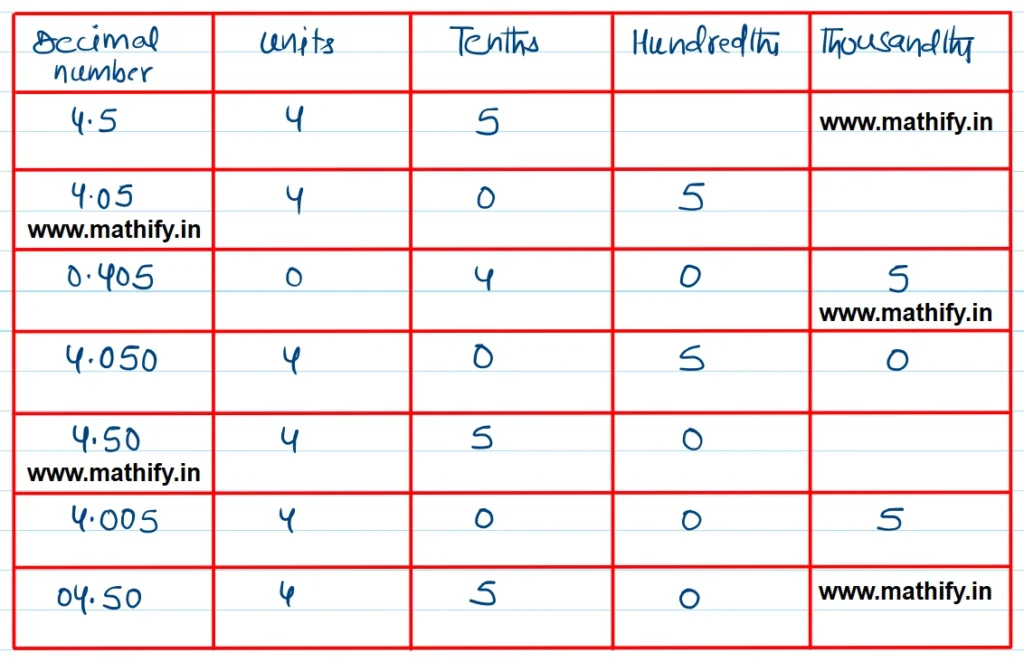
Here’s a more Equal terms are as follows by observing the above table.
Equal Terms:
(1) 4.50 = 04.50
(2) 4.05 = 4.050
Unequal Terms
(1) 0.405
(2) 4.005
Explanation:-
Equality of Decimal Numbers
Trailing zeros do not affect the value of a decimal number.
- Example:
- 4.5 = 4.50 = 04.50
- All represent four ones and five tenths.
Decimals with different numbers of trailing zeros are still equal if the place value remains unchanged.
- Example:
- 4.05 = 4.050
- Both represent four ones and five hundredths.
Inequality of Decimal Numbers
Decimals differ when digits occupy different place values.
- Example:
- (0.405) → four hundred five thousandths
- (4.005) → four ones and five thousandths
- These are not equal, since the digits represent different quantities.
Key Rule
Trailing zeros after the last non-zero digit do not change the value of a decimal.
Changing the position of digits (place value) changes the value of a decimal.
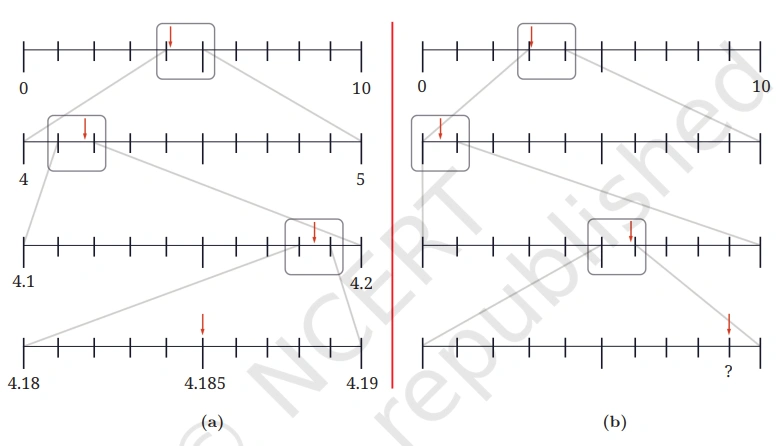
Question: Identify the decimal number in the last number line in Figure (b) denoted by ‘?’.
Solution:

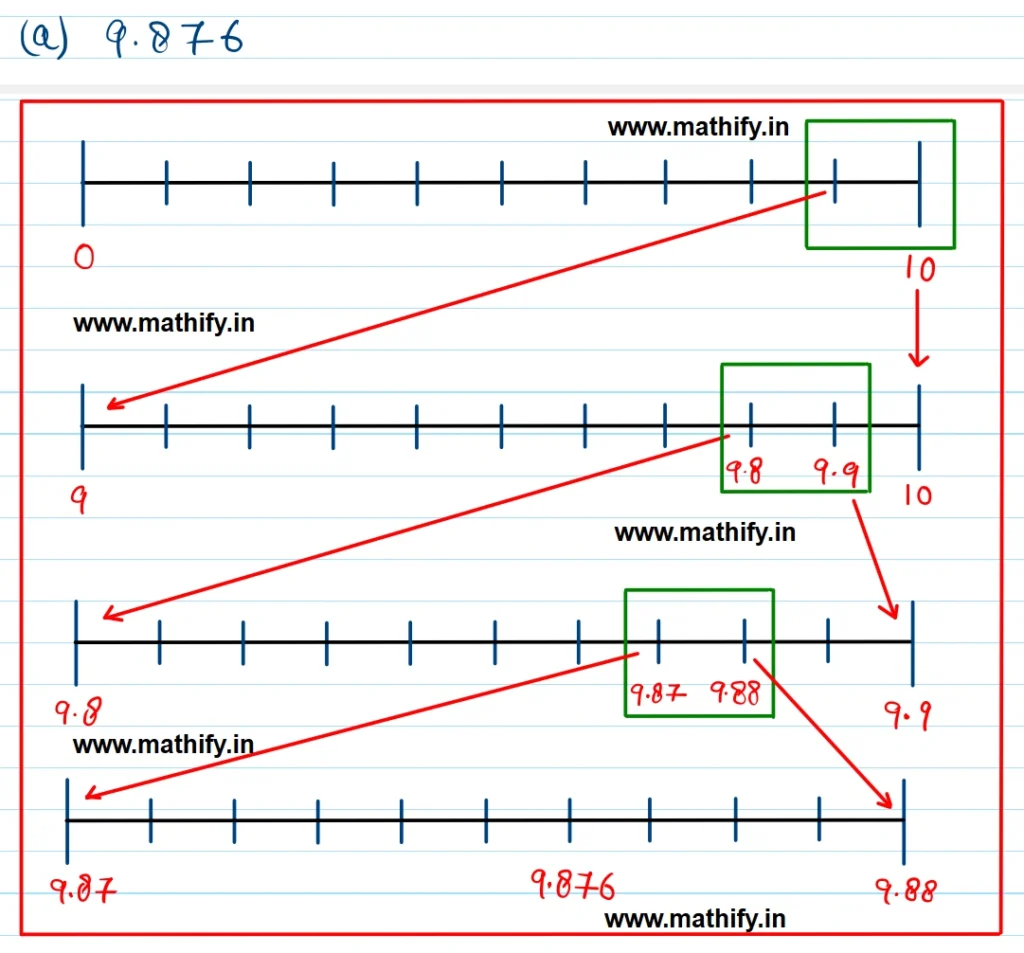
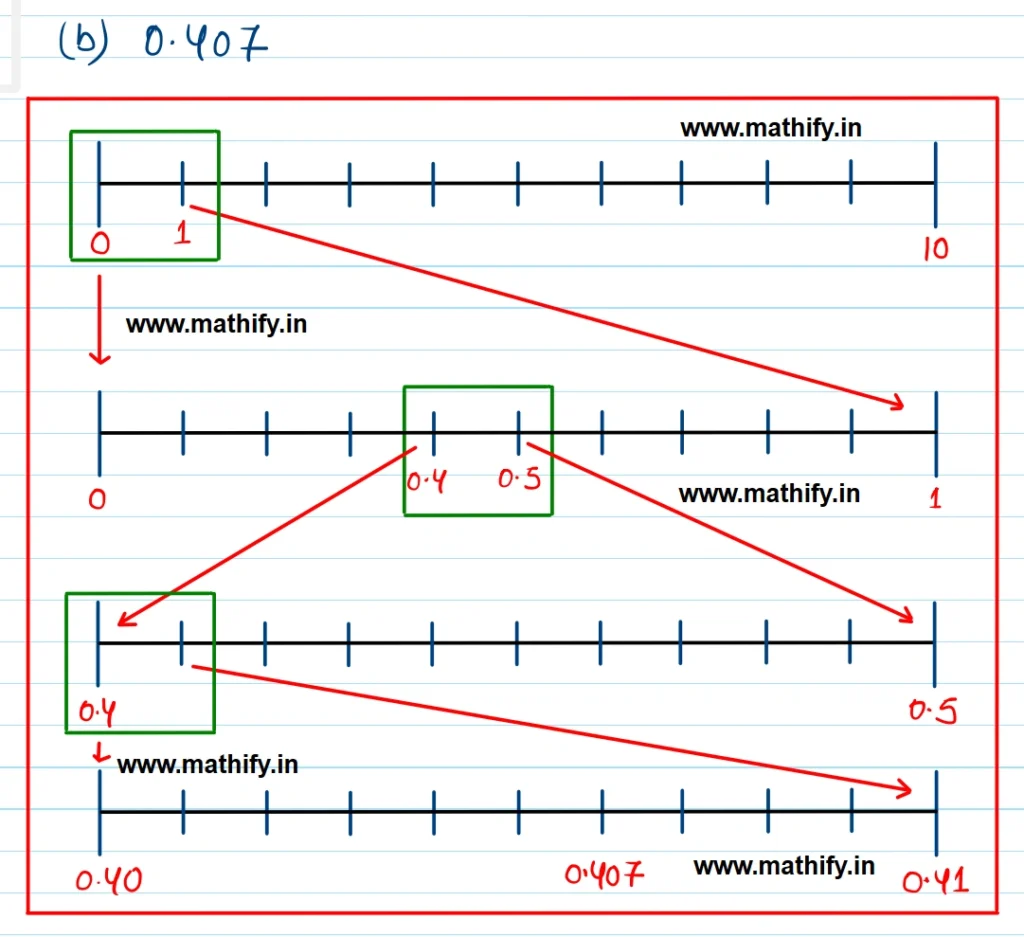
Question: Make such number lines for the decimal numbers:
(a) 9.876
(b) 0.407.
Solution:
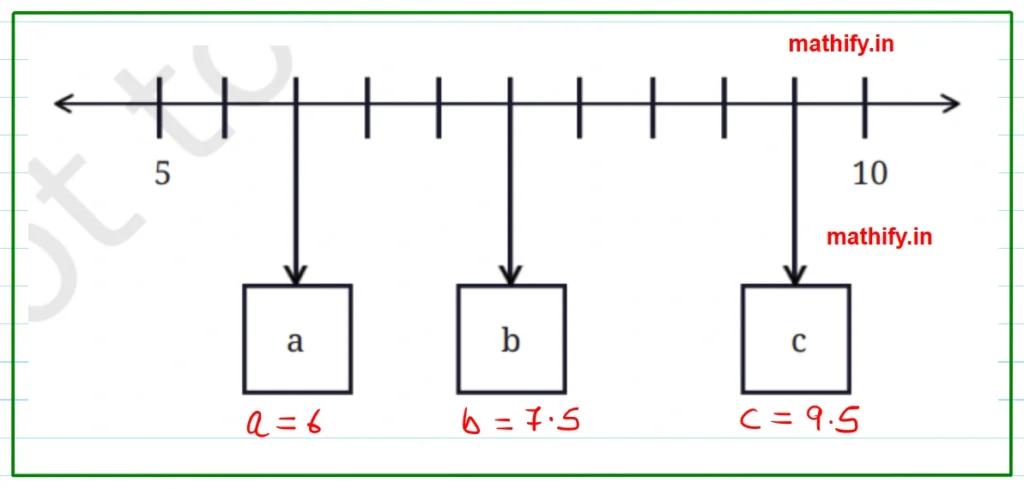
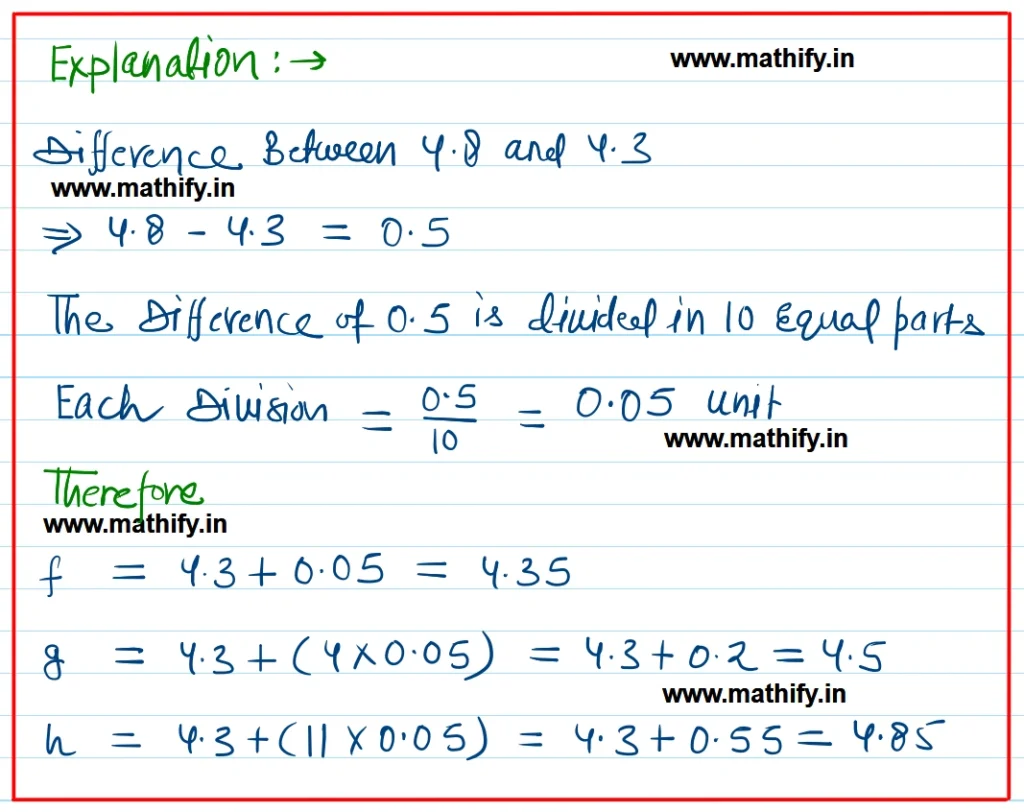
Question: In the number line shown below, what decimal numbers do the boxes labelled ‘a’, ‘b’, and ‘c’ denote?
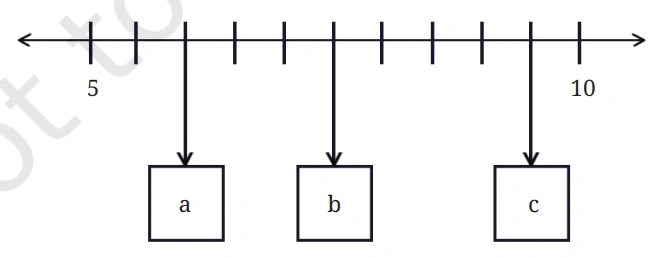
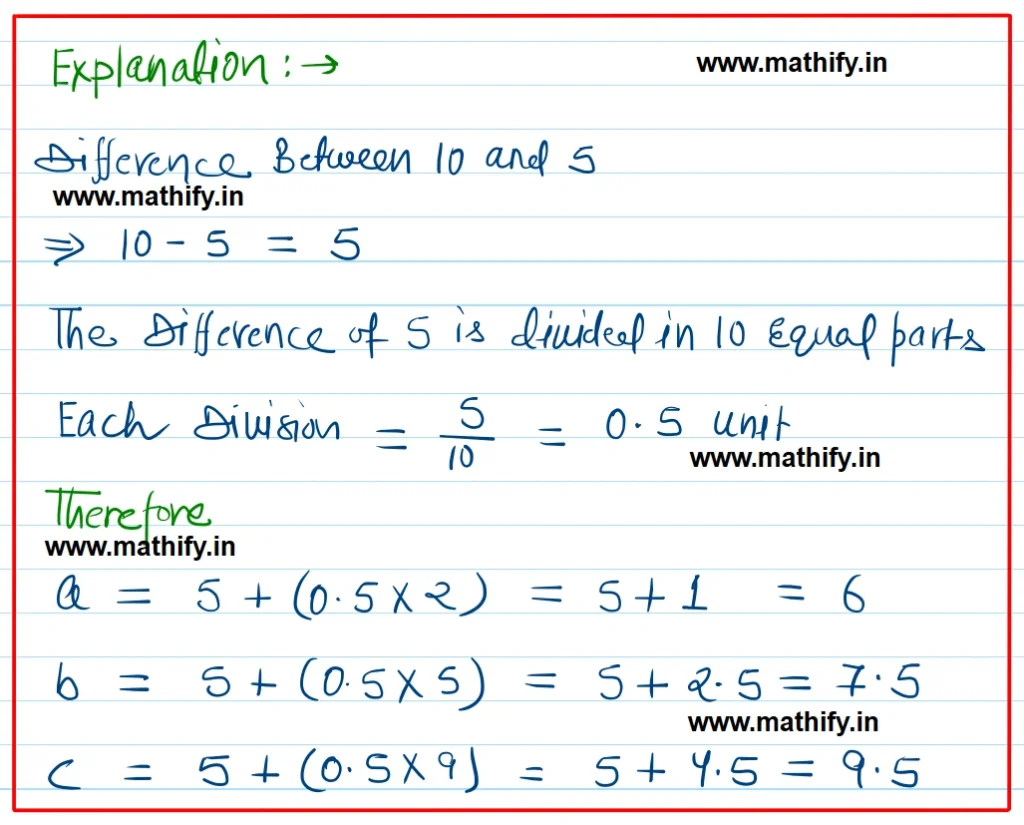
The box with ‘b’ corresponds to the decimal number 7.5; are you able to see how? There are 5 units between 5 and 10, divided into 10 equal parts. Hence, every 2 divisions make a unit, and so every division is 1/2 unit. What numbers do ‘a’ and ‘c’ denote?
Solution:
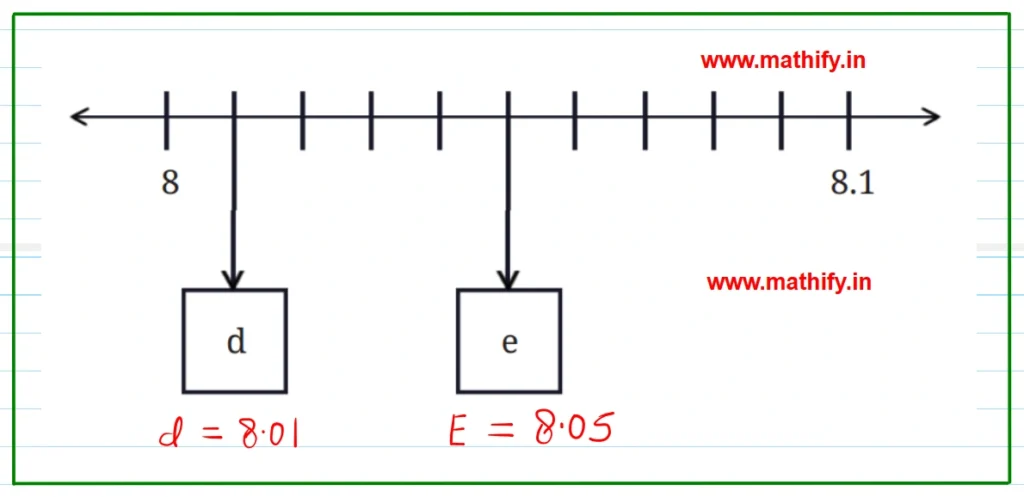
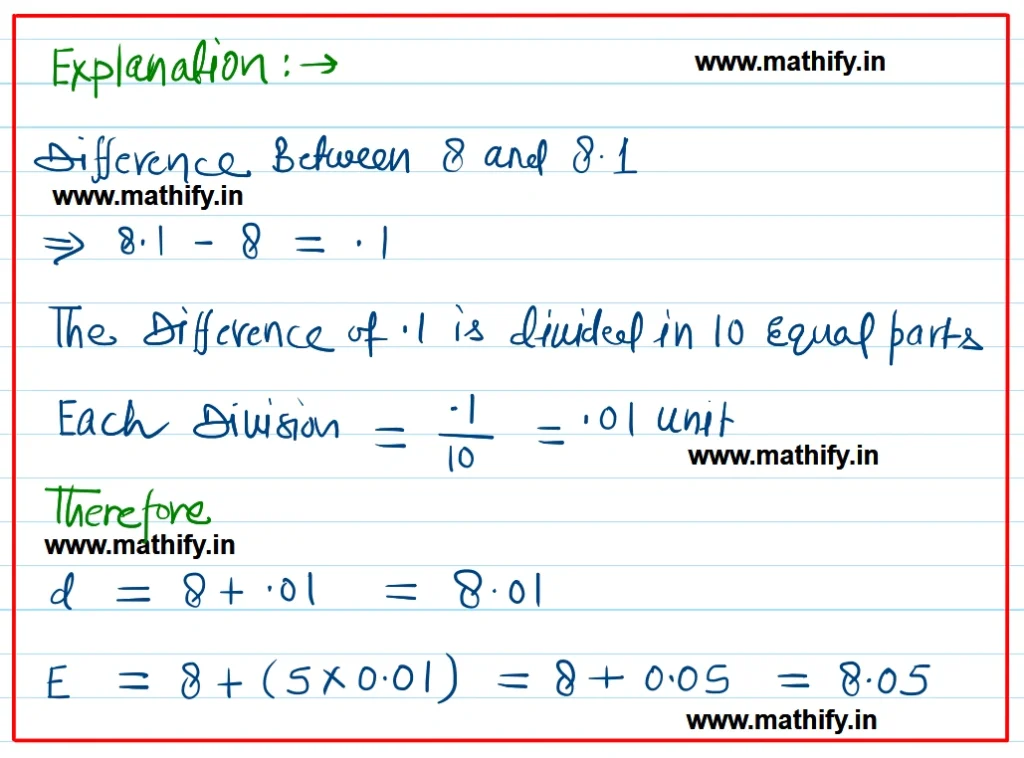
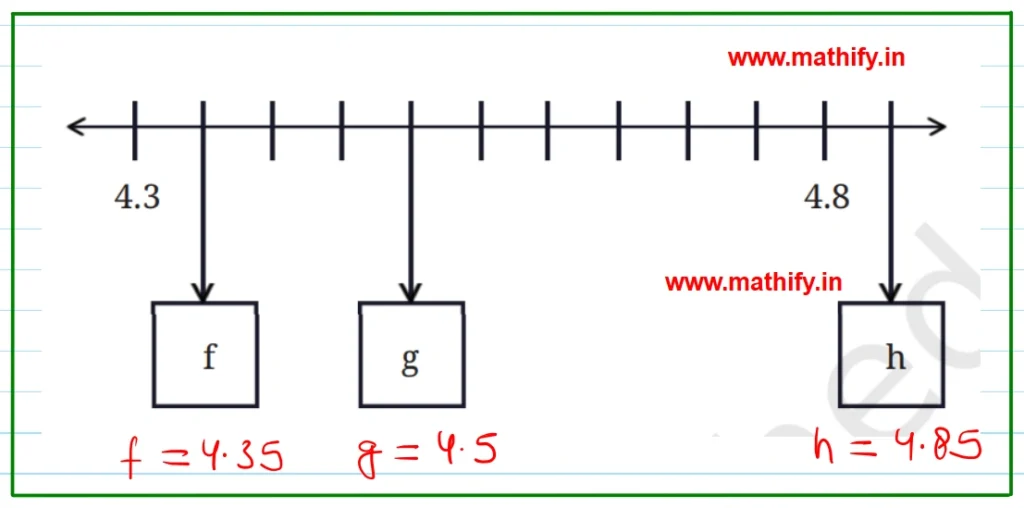
Question: Using similar reasoning, find out the decimal numbers in the boxes below.
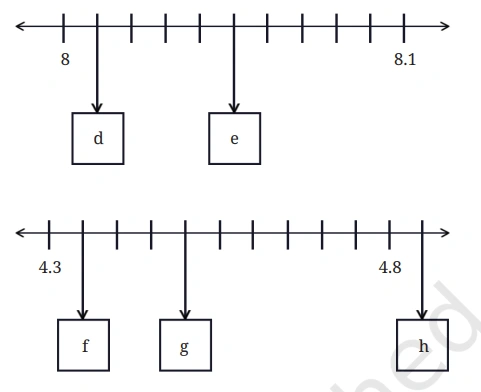
Solution:
Q. Which is larger: 6.456 or 6.465?
Solution:-
Comparing both numbers:
Units Place – Both have 6 in the units place
Tenths Place – Both have 4 in the tenths place
Hundredths Place – 6.456 has 5 in the hundredths place, while 6.465 has 6.
Since 6 > 5,
6.465 is greater than 6.456 at the hundredths place.
Therefore, 6.465 is the larger number.
Question: Why can be stop comparing at this point? Can we be sure that whatever digits are there after this will not affect our conclusion?
Solution:-
When comparing decimal numbers, stop at the place value where the digits are different. The number with the larger digit at that place is the greater number.
Question: Which decimal number is greater?
(a) 1.23 or 1.32
(b) 3.81 or 13.800
(c) 1.009 or 1.090
Solution:
Let’s compare each pair step by step:
(a) 1.23 vs 1.32
- Compare the whole number part: both are 1.
- Compare the tenths place: (2) (in 1.23) vs (3) (in 1.32).
- Since (3 > 2), 1.32 is greater than 1.23.
(b) 3.81 vs 13.800
- Compare the whole number part: (3) vs (13).
- Clearly, (13 > 3).
- So, 13.800 is greater than 3.81.
(c) 1.009 vs 1.090
- Compare the whole number part: both are 1.
- Compare the tenths place: (0) vs (0). Equal.
- Compare the hundredths place: (0) (in 1.009) vs (9) (in 1.090).
- Since (9 > 0), 1.090 is greater than 1.009.
✅ Final Answers:
- (a) 1.32
- (b) 13.800
- (c) 1.090
Closest Decimals
NCERT In-Text Questions Page 73
Question: Which of the above is closest to 1.09?
Solution:
Let’s check each option against 1.09 carefully:
(a) 1.23 vs 1.32
- Both are greater than 1.09.
Distance from 1.09:
(1.23 – 1.09 = 0.14)
(1.32 – 1.09 = 0.23)
1.23 is closer to 1.09.
(b) 3.81 vs 13.800
Both are much greater than 1.09.
Distance from 1.09:
- (3.81 – 1.09 = 2.72)
- (13.800 – 1.09 = 12.71)
3.81 is closer to 1.09.
(c) 1.009 vs 1.090
- Compare directly:
- (1.009) is slightly less than 1.09.
- (1.090 = 1.09) exactly.
So, 1.090 is equal to 1.09 and therefore the closest.
✅ Final Results (closest to 1.09):
- (a) → 1.23
- (b) → 3.81
- (c) → 1.090
Question: Which among these is closest to 4: 3.56, 3.65, 3.099?
Solution:
Let’s compare each number to 4 by finding the difference:
Step 1: Calculate the distance from 4
- (4 – 3.56 = 0.44)
- (4 – 3.65 = 0.35)
- (4 – 3.099 = 0.901)
Step 2: Compare the differences
- (0.44) (for 3.56)
- (0.35) (for 3.65)
- (0.901) (for 3.099)
The smallest difference is (0.35).
✅ Final Answer: 3.65 is closest to 4.
Question: Which among these is closest to 1: 0.8, 0.69, 1.08?
Solution:
Let’s compare each number to 1 by finding the difference:
Step 1: Calculate the distance from 1
- (1 – 0.8 = 0.2)
- (1 – 0.69 = 0.31)
- (1.08 – 1 = 0.08)
Step 2: Compare the differences
- (0.2) (for 0.8)
- (0.31) (for 0.69)
- (0.08) (for 1.08)
The smallest difference is (0.08).
✅ Final Answer: 1.08 is closest to 1.
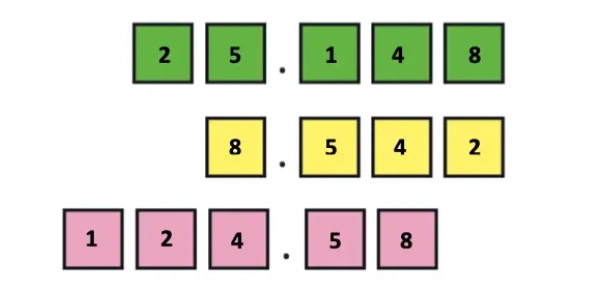
Question: In each case below use the digits 4, 1, 8, 2, and 5 exactly once and try to make a decimal number as close as possible to 25.
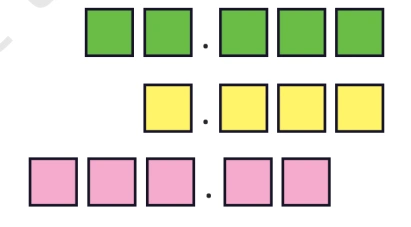
Solution:
3.7 Addition and Subtraction of Decimals
NCERT In-Text Questions Pages 75
Question: Write the detailed place value computation for 84.691 – 77.345, and its compact form.
Solution:
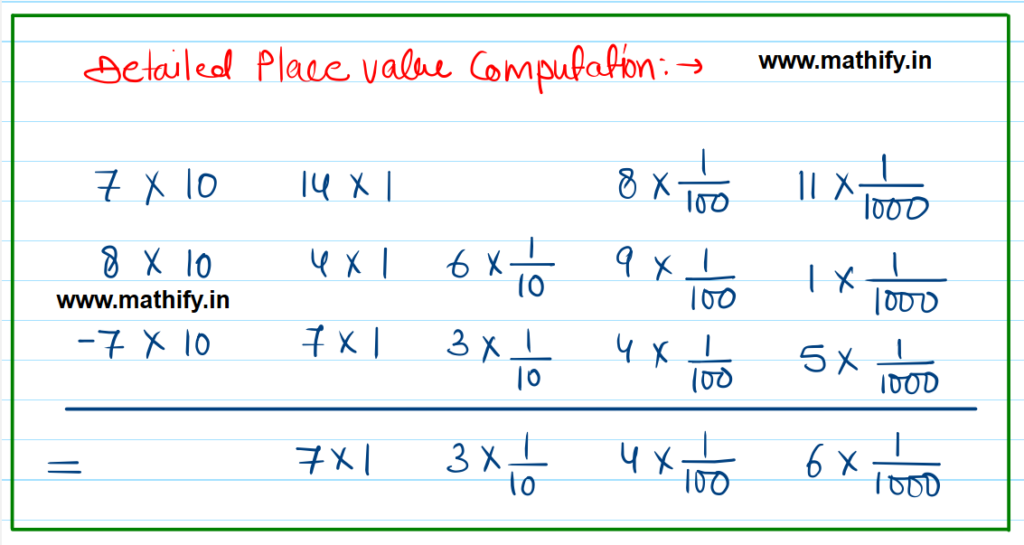
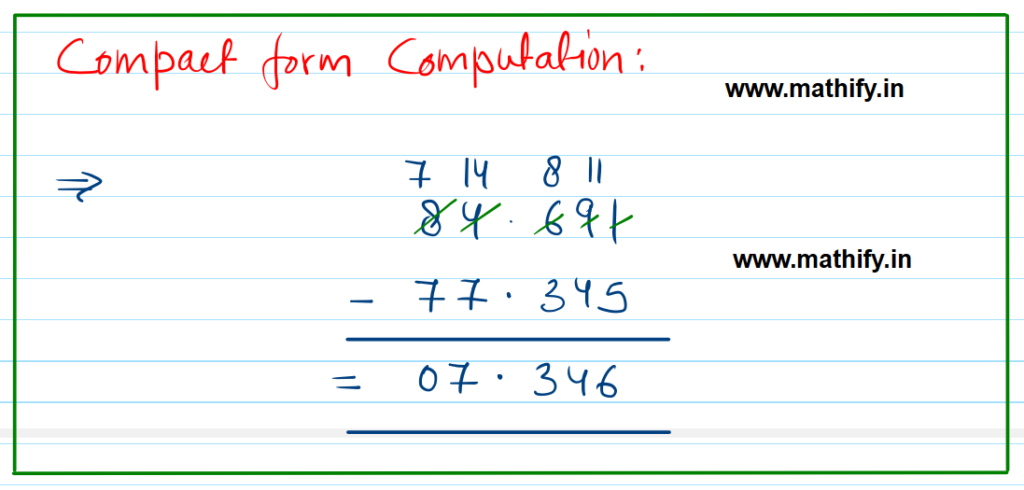
Figure it Out
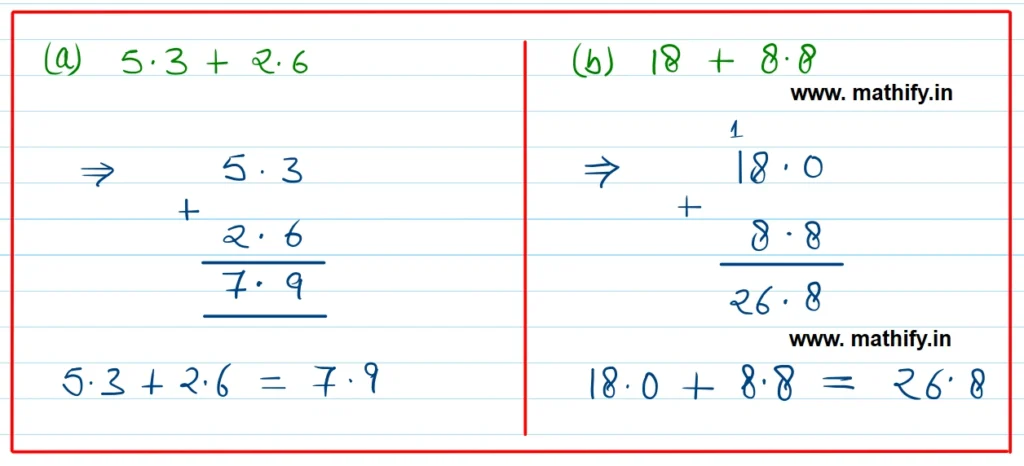
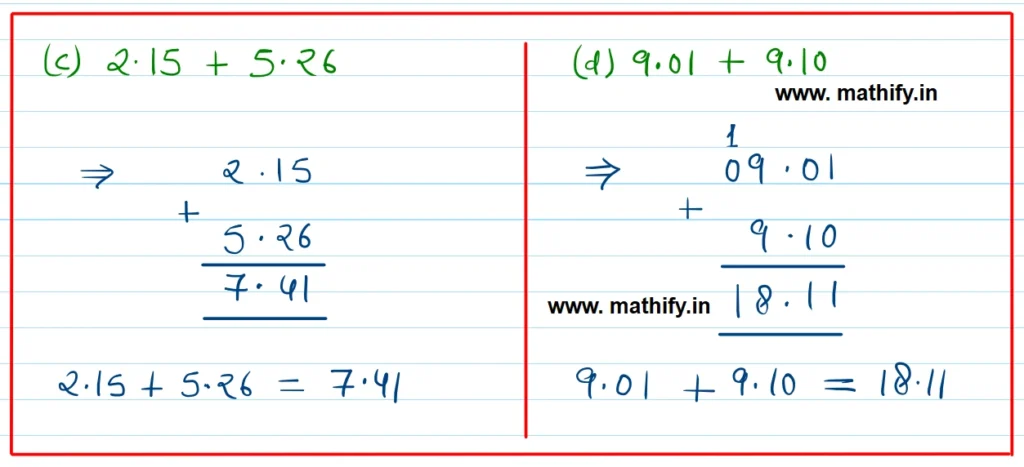
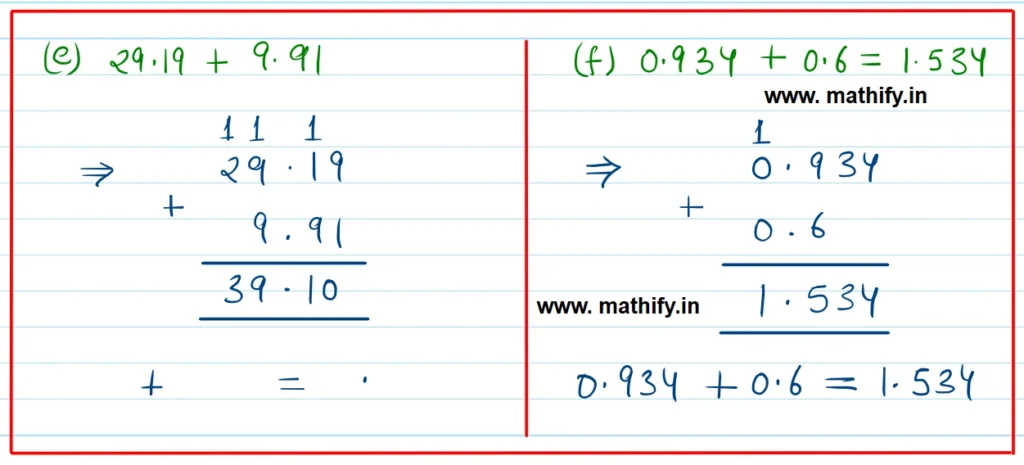
Question 1: Find the sums
(a) 5.3 + 2.6
(b) 18 + 8.8
(c) 2.15 + 5.26
(d) 9.01 + 9.10
(e) 29.19 + 9.91
(f) 0.934 + 0.6
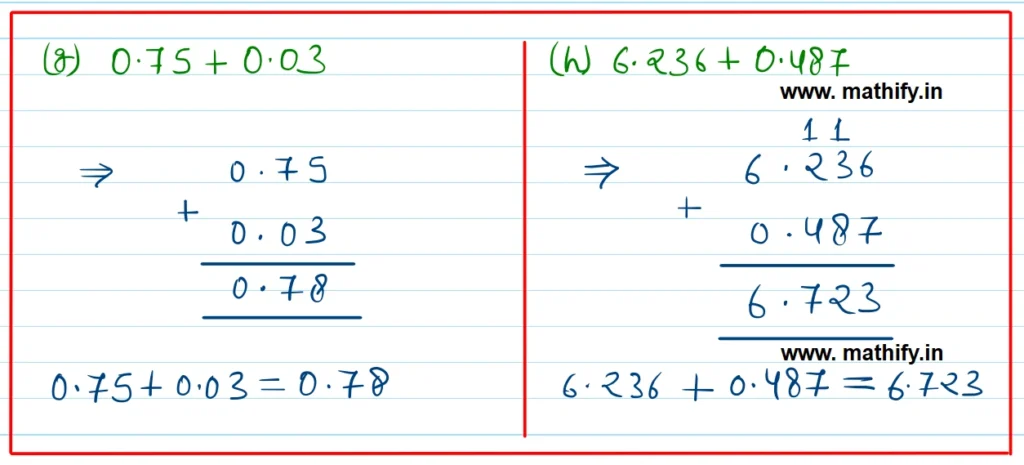
(g) 0.75 + 0.03
(h) 6.236 + 0.487
Solution:
Question 2: Find the differences
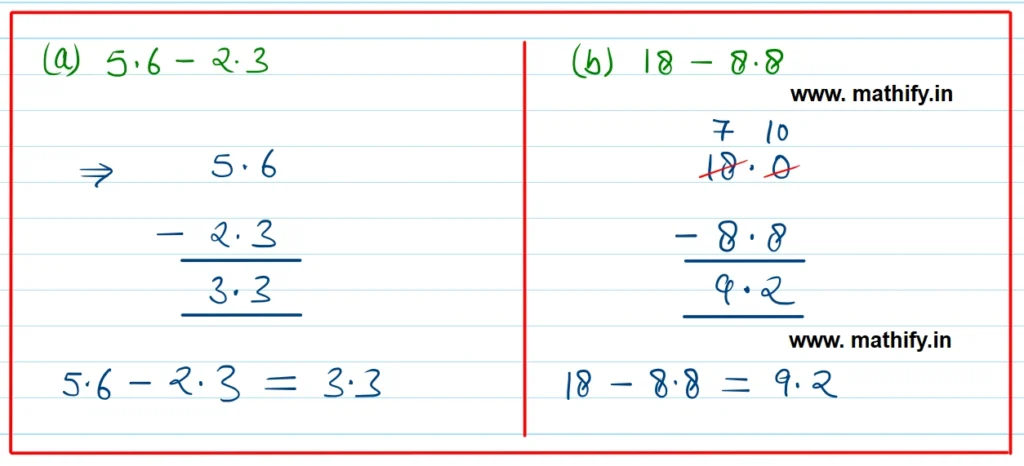
(a) 5.6 – 2.3 (b) 18 – 8.8
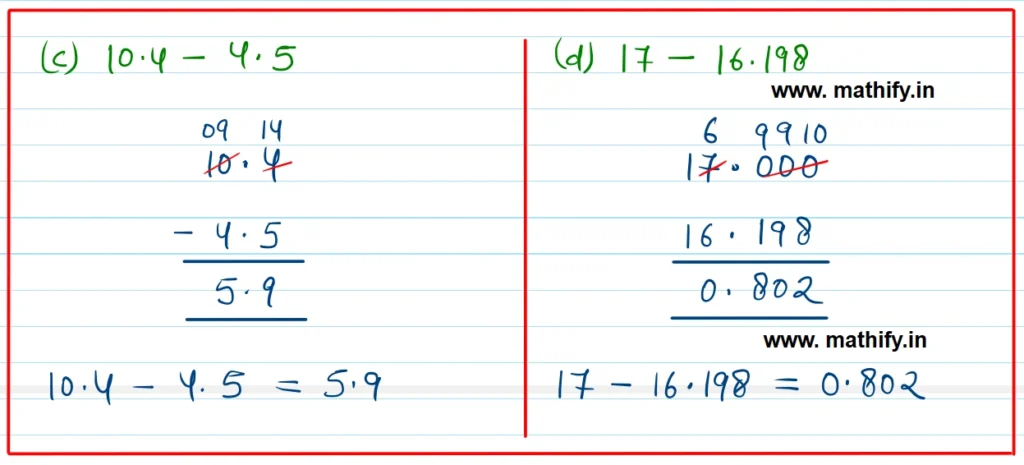
(c) 10.4 – 4.5 (d) 17 – 16.198
(e) 17 – 0.05 (f) 34.505 – 18.1
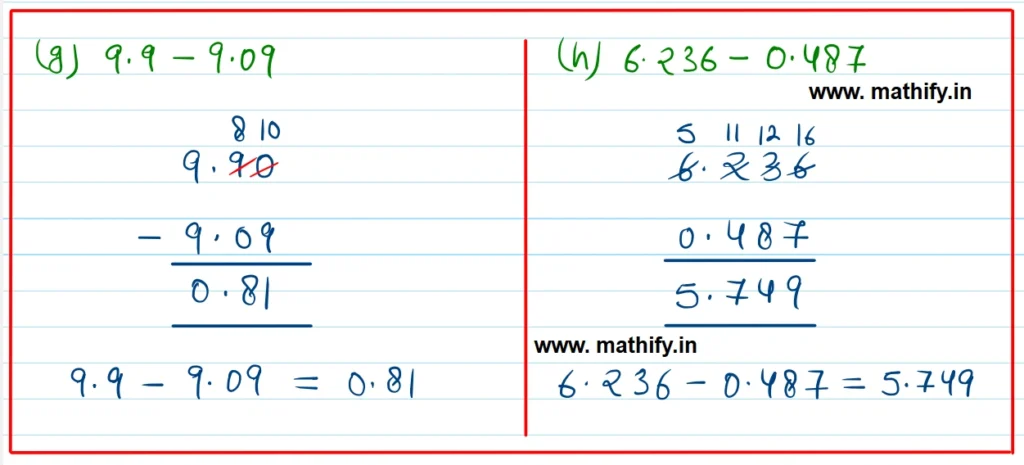
(g) 9.9 – 9.09 (h) 6.236 – 0.487
Solution:

Decimal Sequences
NCERT In-Text Questions Pages (75-76)
Question: Observe this sequence of decimal numbers and identify the change after each term. 4.4, 4.8. 5.2, 5.6, 6.0, …
Solution:
Let’s analyze the sequence step by step:
Sequence:
4.4, 4.8, 5.2, 5.6, 6.0, …
Step 1: Find the difference between consecutive terms
- (4.8 – 4.4 = 0.4)
- (5.2 – 4.8 = 0.4)
- (5.6 – 5.2 = 0.4)
- (6.0 – 5.6 = 0.4)
Step 2: Identify the pattern
- Each term increases by 0.4.
Step 3: Predict the next terms
- After (6.0), the next term will be:
(6.0 + 0.4 = 6.4) - Then:
(6.4 + 0.4 = 6.8) - And so on.
✅ Final Answer: The change after each term is +0.4.
The sequence continues as: 6.4, 6.8, 7.2, …
Question: Similarly, identify the change and write the next 3 terms for each sequence given below. Try to do this computation mentally.
(a) 4.4, 4.45, 4.5, …
(b) 25.75, 26.25, 26.75, …
(c) 10.56, 10.67, 10.78, …
(d) 13.5, 16, 18.5, …
(e) 8.5, 9.4, 10.3, …
(f) 5, 4.95, 4.90, …
(g) 12.45, 11.95, 11.45, …
(h) 36.5, 33, 29.5, …
Solution:
(a) 4.4, 4.45, 4.5, ___ ___ ___
Each term increases by 0.05
Next after 4.5: 4.5 + 0.05 = 4.55
Next: 4.55 + 0.05 = 4.6
Next: 4.6 + 0.05 = 4.65
Hence, the next 3 terms are 4.55, 4.6, 4.65
(b) 25.75, 26.25, 26.75 ___ ____ ____
Each term increases by 0.5
Next after 26.75: 26.75 + 0.5 = 27.25
Next: 27.25 + 0.5 = 27.75
Next: 27.75 + 0.5 = 28.25
Hence, the next 3 terms are 27.25, 27.75, 28.25
(c) 10.56, 10.67, 10.78, ___ ___ ___
Each term increases by 0.11
Next after 10.78: 10.78 + 0.11 = 10.89
Next: 10.89 + 0.11 = 11.00
Next: 11.00 + 0.11 = 11.11
Hence, the next 3 terms are 10.89, 11.00, 11.11
(d) 13.5, 16, 18.5, ___ ___ ___
Each term increases by 2.5
Next afer 18.5: 18.5 + 2.5 = 21.0
Next: 21.0 + 2.5 = 23.5
Next: 23.5 + 2.5 = 26.0
Hence, Next 3 terms are 21.0, 23.5, 26.0
(e) 8.5, 9.4, 10.3, ___ ___ ___
Each term increases by 0.9
Next after 10.3: 10.3 + 0.9 = 11.2
Next: 11.2 + 0.9 = 12.1
Next: 12.1 + 0.9 = 13.0
Hence, the next 3 terms are 11.2, 12.1, 13.0
(f) 5, 4.95, 4.90, ___ ___ ___
Each term decreases by 0.05
Next after 4.90: 4.90 – 0.05 = 4.85
Next: 4.85 – 0.05 = 4.80
Next: 4.80 – 0.05 = 4.75
Hence, the next 3 terms are 4.85, 4.80, 4.75
(g) 12.45, 11.95, 11.45, ___ ____ ___
Each term decreases by 0.5
Next after 11.45: 11.45 – 0.5 = 10.95
Next: 10.95 – 0.5 = 10.45
Next: 10.45 – 0.5 = 9.95
Hence, the next 3 terms are 10.95, 10.45, 9.95
(h) 36.5, 33, 29.5,___ ____ ____
Each term decreases by 3.5
Next after 29.5: 29.5 – 3.5 = 26.0
Next: 26.0 – 3.5 = 22.5
Next: 22.5 – 3.5 = 19.0
Hence, Next 3 terms are 26.0, 22.5, 19.0
Question: Make your own sequences and challenge your classmates to extend the pattern.
Solution:
Estimating Sums and Differences
NCERT In-Text Questions Pages 76
Sonu has observed sums and differences of decimal numbers and says, “If we add two decimal numbers, then the sum will always be greater than the sum of their whole number parts. Also, the sum will always be less than 2 more than the sum of their whole number parts.”
Let us use an example to understand what his claim means: If the two numbers to be added are 25.936 and 8.202, the claim is that their sum will be greater than 25 + 8 (whole number parts) and will be less than 25 + 1 + 8 + 1.
Quesion: What do you think about this claim? Verify if this is true for these numbers. Will it work for any 2 decimal numbers?
Solution:
The given numbers are 25.936 and 8.202
Sum of whole number parts = 25 + 8 = 33
Sum of given decimal numbers = 25.936 + 8.202 = 34.138
Hence, 33 < 34.138 < (33 + 2) It is verified.
Lets verify it with other two decimal numbers
1.642 and 4.365
Sum of whole number part = 1 + 4 = 5
Sum of given decimal numbers = 1.642 + 4.365 = 5.827
Hence, 5 < 5.827 < 5 + 2 it is verified.
So, the claim is true for the sum of any two decimal numbers.
Question: What about for the sum of 25.93603259 and 8.202?
Solution:
The given numbers are 25.93603259 and 8.202.
Sum of whole number parts = 25 + 8 = 33
Sum of given decimal numbers = 25.93603259 + 8.202 = 34.13803259
Hence, 33 < 34.13803259 < (33 + 2) it is verified.
Question: Similarly, come up with a way to narrow down the range of whole numbers within which the difference of two decimal numbers will lie.
Solution:
Here’s a clear, systematic way to narrow down the range of whole numbers within which the difference of two decimal numbers will lie:
Step 1: Identify the two decimal numbers
Let the numbers be (a) and (b), with (a > b).
We want to find the difference:
[ d = a – b ]
Step 2: Look at the whole number parts
- The difference of the whole number parts gives the minimum possible range.
- The difference plus 1 gives the maximum possible range (since decimals can add up to nearly one more whole number).
Step 3: General Rule
If the whole number parts are (m) and (n) (with (m > n)):
[ m – n \leq d < (m – n) + 1 ]
So the difference will always lie between two consecutive whole numbers.
Step 4: Examples
- 6.2 and 4.8
- Whole number parts: 6 and 4 → difference = 2.
- Range: (2 ≤ d < 3).
- Actual difference: (6.2 – 4.8 = 1.4), which lies in the range.
- 12.75 and 9.05
- Whole number parts: 12 and 9 → difference = 3.
- Range: (3 ≤ d < 4).
- Actual difference: (12.75 – 9.05 = 3.7), which lies in the range.
✅ Final Rule:
The difference of two decimal numbers always lies between the difference of their whole number parts and one more than that difference.
3.8 More on the Decimal
System Deceptive Decimal Notation
NCERT In-Text Questions Pages 78
Question: Where else can we see such ‘non-decimals’ with a decimal-like notation?
Solution:
That’s a thoughtful question! Decimal-like notation isn’t unique to decimals in mathematics. We often see “non-decimals” written with a decimal-style format in other contexts where the dot (or separator) doesn’t mean tenths, hundredths, etc., but something else entirely. Here are some examples:
1. Time Notation
- Example: 4.30 (meaning 4 hours and 30 minutes, not 4.3 hours).
- The dot here separates hours and minutes, not whole numbers and tenths.
2. Version Numbers
- Example: Software version 2.5 or 3.14.
- The dot separates major and minor versions, not decimal places.
- Version 3.14 is not “three point one four” in a mathematical sense—it’s “version 3, update 14.”
3. IP Addresses
- Example: 192.168.0.1
- Each section is a separate integer, and the dots are separators, not decimal points.
4. Roll Numbers / Codes
- Example: Student roll number 12.05 or invoice code 7.21.
- The dot separates categories (like class and student number), not tenths and hundredths.
5. Sports Scores or Records
- Example: Cricket bowling figures 4.5 overs (meaning 4 overs and 5 balls, not 4.5 overs mathematically).
- The dot separates overs and balls.
✅ Key Insight:
The dot (.) is a separator symbol in many contexts, not always a decimal point. It can mean “next category,” “next unit,” or “next identifier,” depending on the system.
Figure it Out Page 78-79
Figure it Out
Question 1: Convert the following fractions into decimals:
(a) 5/100 (b) 16/1000 (c) 12/10 (d) 254/1000
Solution:
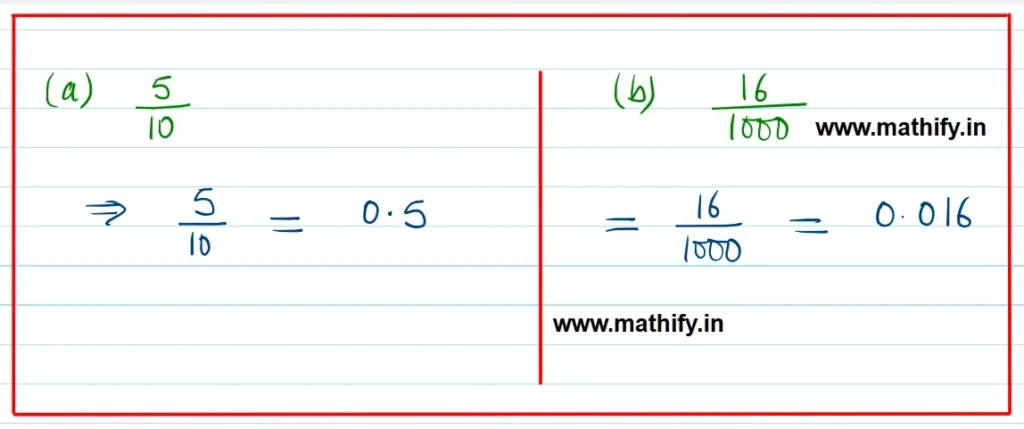
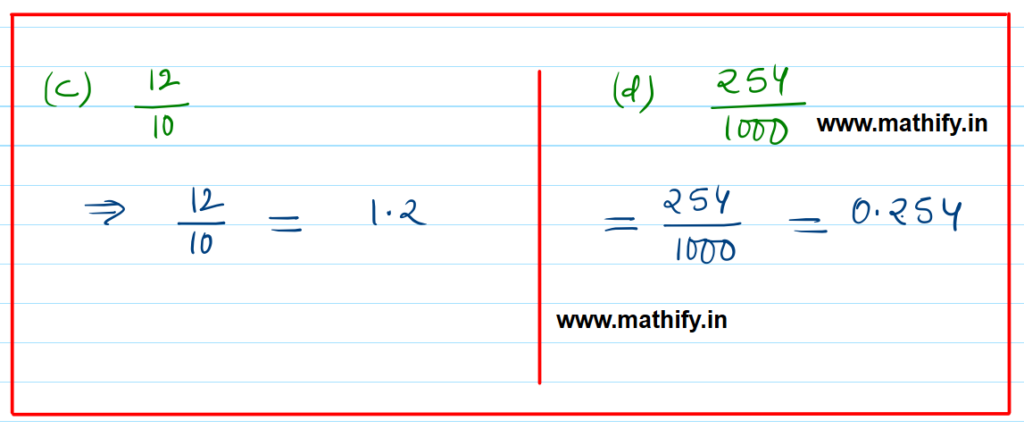
Question 2: Convert the following decimals into a sum of tenths, hundredths and thousandths:
(a) 0.34 (b) 1.02 (c) 0.8 (d) 0.362
Solution:

Question 3. What decimal number does each letter represent in the number line below?

Solution:
Difference between 6.4 and 6.6 = 0.2
0.2 is divided in 8 equal parts.
Each part = 0.2/8 = 0.025
Therefore,
a = 6.4 + (2 x 0.025) = 6.4 + 0.050 = 6.425
c = 6.4 + (5 x 0.025) = 6.4 + 0.125 = 6.525
b = 6.4 + (6 x 0.025) = 6.4 + 0.150 = 6.550
Question 4. Arrange the following quantities in descending order:
(a) 11.01, 1.011, 1.101, 11.10, 1.01
(b) 2.567, 2.675, 2.768, 2.499, 2.698
(c) 4.678 g, 4.595 g, 4.600 g, 4.656 g, 4.666 g
(d) 33.13 m, 33.31 m, 33.133 m, 33.331 m, 33.313 m
Solution:
Question 5: Using the digits 1, 4, 0, 8, and 6 make:
(a) the decimal number closest to 30
(b) the smallest possible decimal number between 100 and 1000.
Solution:
Let’s assume each digit 1, 4, 0, 8, 6 is used exactly once and we’re allowed to place the decimal point wherever we want.
(a) Decimal number closest to 30
We can’t actually make 30 (no digit 3), so we check the nearest possibilities.
- The largest number below 30 we can make is 18.406
(using 1, 8 | 4, 0, 6) - The smallest number above 30 we can make is 40.168
(using 4, 0 | 1, 6, 8)
Now compare distances from 30:
- (30 – 18.406 = 11.594)
- (40.168 – 30 = 10.168)
👉 40.168 is closer to 30
Answer (a): 40.168
(b) Smallest possible decimal number between 100 and 1000
To make it as small as possible:
- Use the smallest hundreds digit → 1
- Then the smallest tens digit → 0
- Then the smallest units digit → 4
So the integer part is 104
The remaining digits are 6 and 8, and the smaller decimal is .68
Answer (b): 104.68
✅ Final Answers
- (a) 40.168
- (b) 104.68
Question 6: Will a decimal number with more digits be greater than a decimal number with fewer digits?
Solution:
Great question — and a very common confusion 🙂
No, a decimal number with more digits is NOT always greater than one with fewer digits.
What matters is place value, not the number of digits.
Let’s look at this step by step.
1️⃣ Compare the whole-number part first
- 12.3 and 9.87654
Even though 9.87654 has more digits,
👉 12.3 > 9.87654 because 12 > 9.
2️⃣ If whole numbers are the same, compare digit by digit
- 4.56 and 4.567
- Units: same (4)
- Tenths: same (5)
- Hundredths: same (6)
- Thousandths: second number has 7, first has 0
👉 4.567 > 4.56, even though it has more digits.
3️⃣ More digits can be smaller
- 5.9 and 5.123456
👉 5.9 > 5.123456
Why?
Because 9 tenths is bigger than 1 tenth, no matter how many extra digits follow.
🔑 Key idea to remember
Extra digits to the right only refine the number — they don’t automatically make it larger.
A useful trick:
- Write both numbers with the same number of decimal places by adding zeros.
Example:
- 5.9 = 5.900
- 5.123 = 5.123
Now comparison becomes easy.
✅ Conclusion
A decimal number with more digits
✔️ can be greater
✔️ can be smaller
❌ is not always greater
Question 7: Mahi purchases 0.25 kg of beans, 0.3 kg of carrots, 0.5 kg of potatoes, 0.2 kg of capsicums, and 0.05 kg of ginger. Calculate the total weight of the items she bought.
Solution:
Beans = 0.25 Kg
Carrots = 0.3 Kg
Potatoes = 0.5 Kg
Capscicum = 0.2 Kg
Ginger = 0.05 Kg
Total Weight
= (0.25 + 0.3 + 0.5 + 0.2 + 0.05)Kg = 1.3 Kg
Question 8. Pinto supplies 3.79 L, 4.2 L, and 4.25 L of milk to a milk dairy in the first three days. In 6 days, he supplies 25 litres of milk. Find the total quantity of milk supplied to the dairy in the last three days.
Solution:
Milk supplied in first 3 days
= 3.79 + 4.2 + 4.25 = 12.24 L
Milk supplied in 6 days = 25 L
Milk supplied in last three days
= 25 L – 12.24 L = 12.76
Question 9. Tinku weighed 35.75 kg in January and 34.50 kg in February. Has he gained or lost weight? How much is the change?
Solution:
Tinku’s weight:
In January = 35.75 Kg
In February = 34.50 Kg
Change in weight = 35.75 Kg – 34.50 Kg = 1.25 Kg
Tinku has lost weight and the change in weight is 1.25 Kg.
Question 10. Extend the pattern: 5.5, 6.4, 6.39, 7.29, 7.28, 6.18, 6.17, , _
Solution:
Let us analyse the given pattern:
5.5 (+0.9) 6.4 (-0.01) 6.39 (+0.9) 7.29 (-0.01) 7.28 (+0.9) 8.18 (-0.01) 8.17.
So, the sequence follows an increasing trend of 0.9 and then a decreasing trend of 0.01 alternatively.
Thus, the next two numbers are 9.07 and 9.06.
Question 11. How many millimeters make 1 kilometer?
Solution:
We know that 1 km = 1000 m and 1 m = 1000 mm
Therefore, 1 km = 1000 × 1000 mm= 1000000 mm
Question 12: Indian Railways offers optional travel insurance for passengers who book e-tickets. It costs 45 paise per passenger. If 1 lakh people opt for insurance in a day, what is the total insurance fee paid?
Solution:
The insurance fee paid for 1 passenger = 45 p = ₹ 0.45
So, the total insurance fee paid for 1 lakh passengers
= ₹ 0.45 × 100000 = ₹ 45000
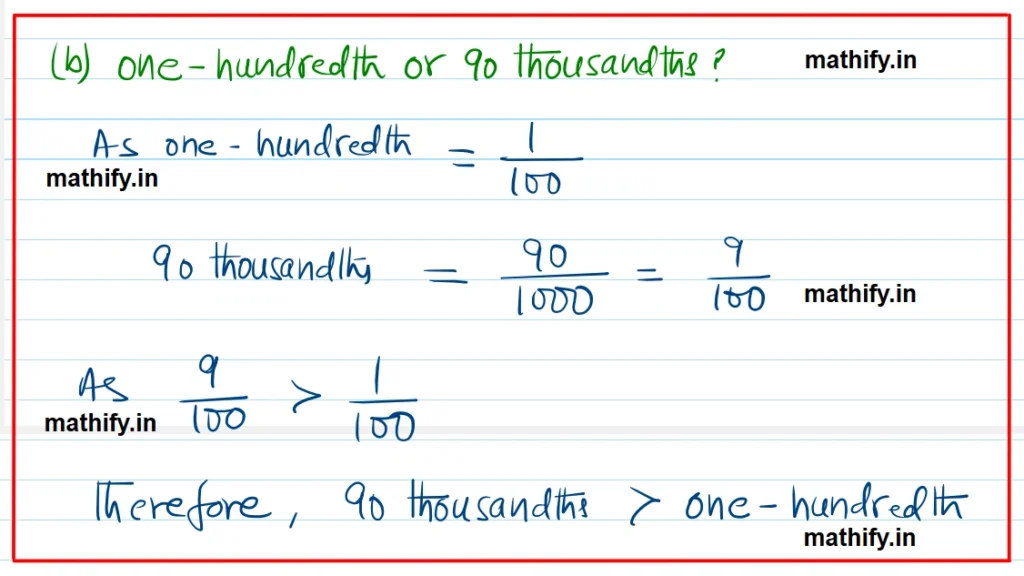
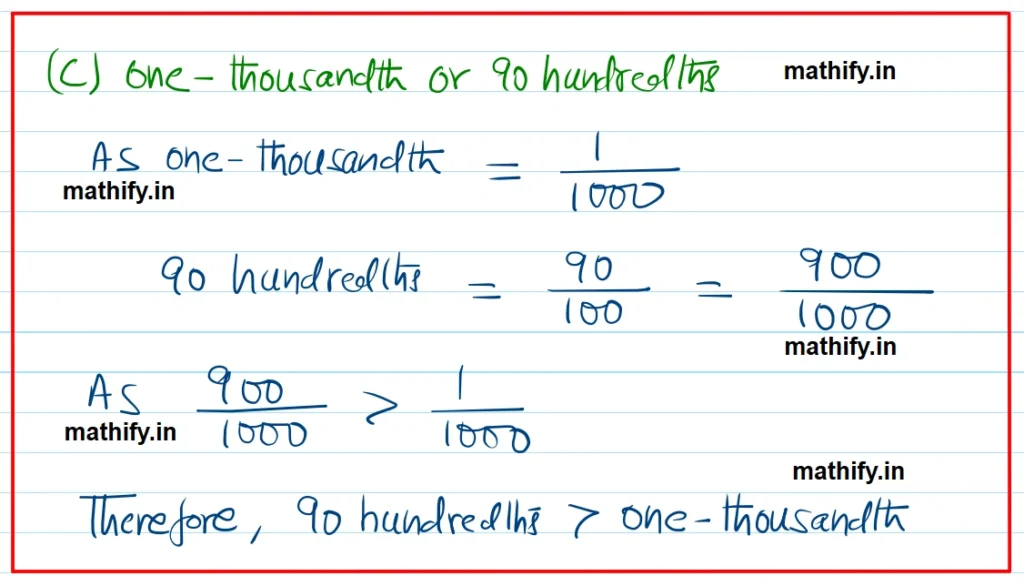
Question 13: Which is greater?
(a) 10/1000 or 1/10 ?
(b) One-hundredth or 90 thousandths?
(c) One-thousandth or 90 hundredths?
Solution:

Question 14: Write the decimal forms of the quantities mentioned (an example is given):
(a) 87 ones, 5 tenths and 60 hundredths = 88.10
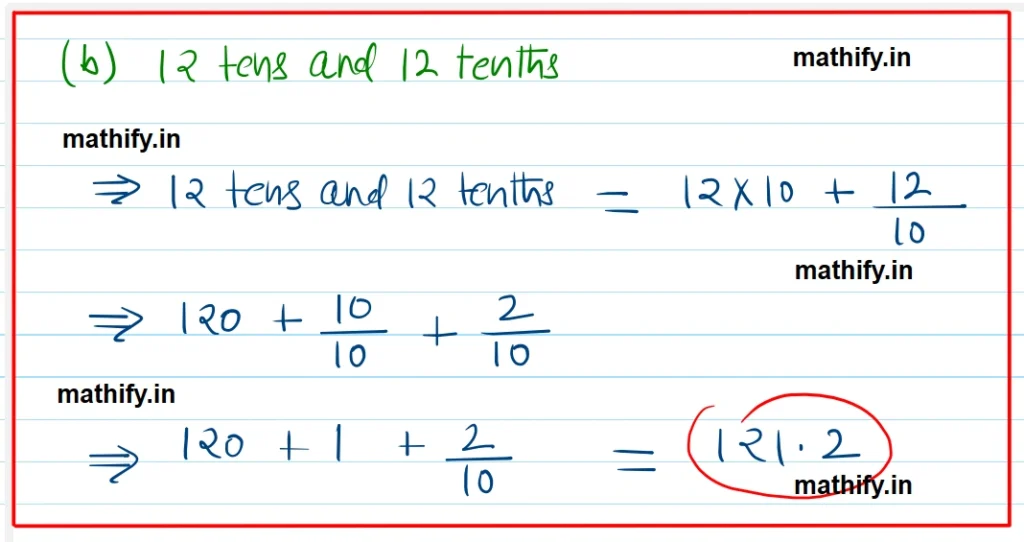
(b) 12 tens and 12 tenths
(c) 10 tens, 10 ones, 10 tenths, and 10 hundredths
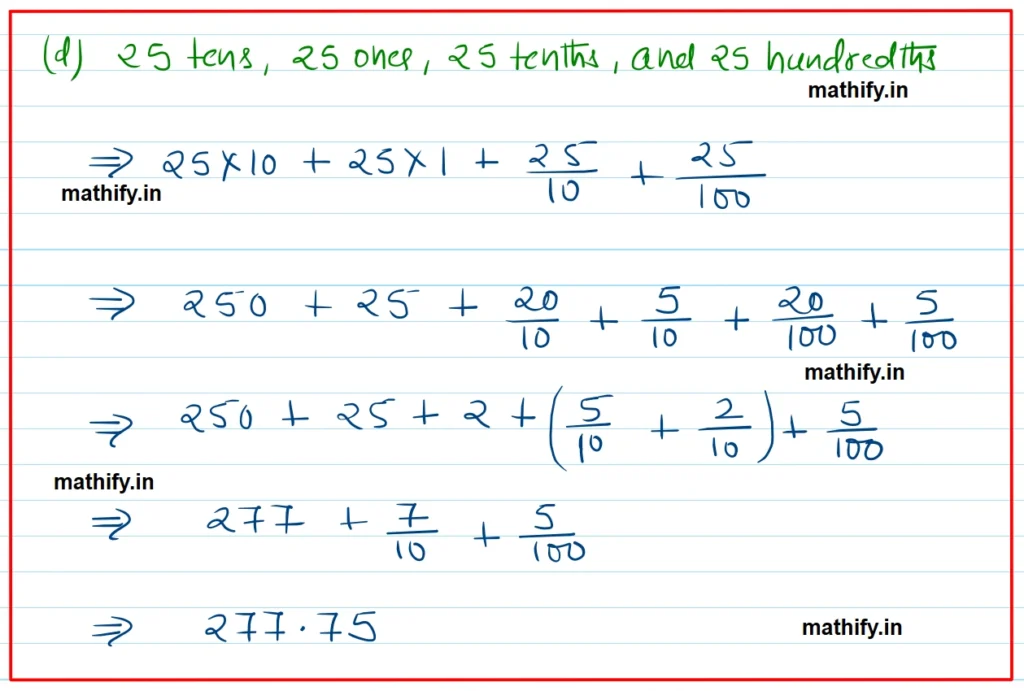
(d) 25 tens, 25 ones, 25 tenths, and 25 hundredths
Solution:

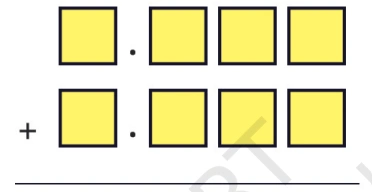
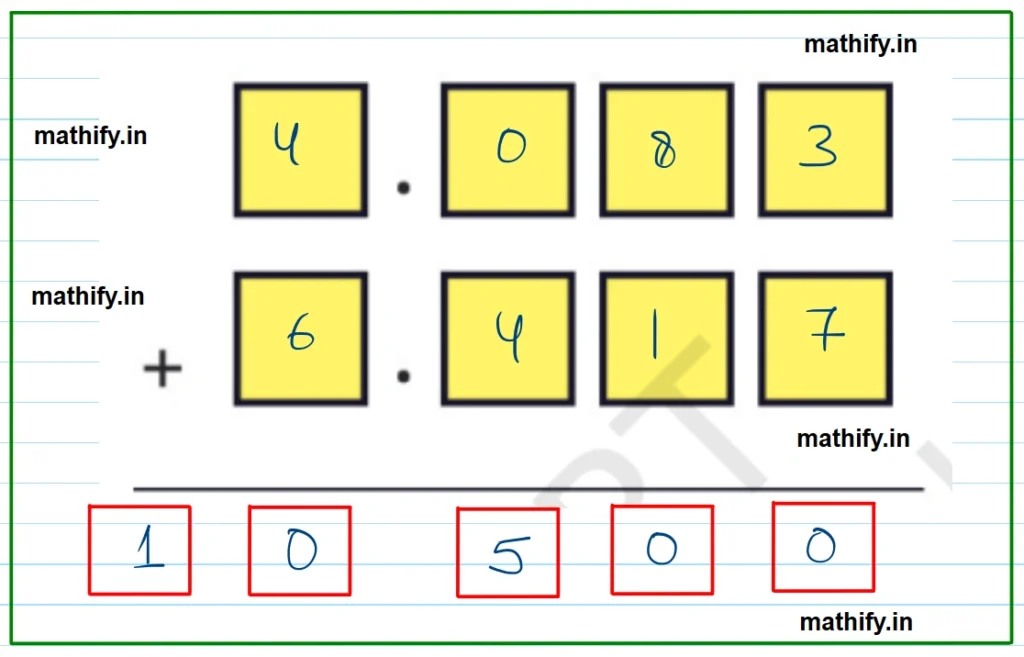
Question 15: Using each digit 0 – 9 not more than once, fill the boxes below so that the sum is closest to 10.5:
Solution:
Question 16: Write the following fractions in decimal form:
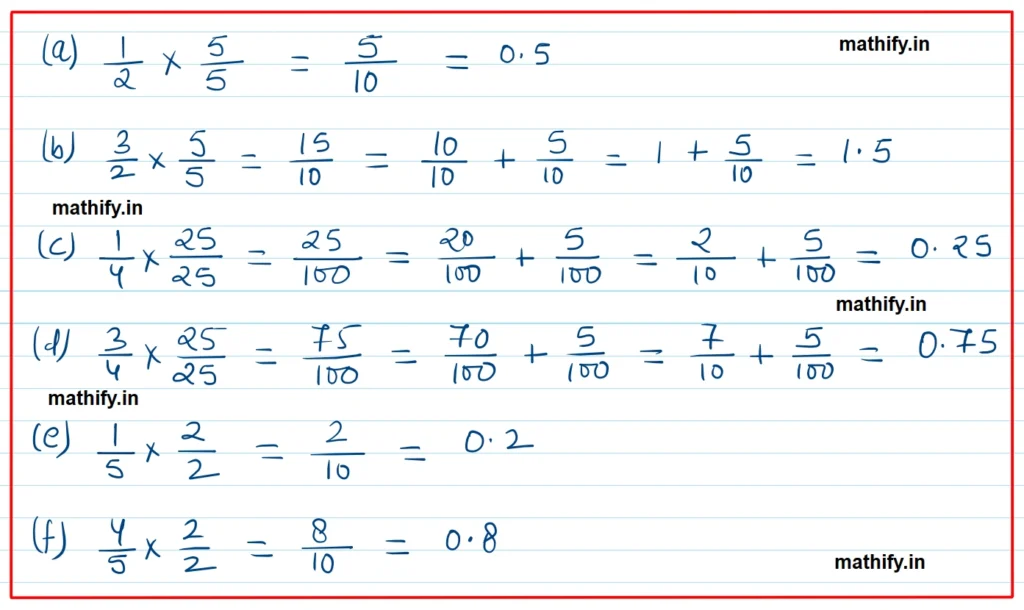
(a) 1/2
(b) 3/2
(c) 1/4
(d) 3/4
(e) 1/5
(f) 4/5
Solution: